
A driver refused your service dog in Florida: what to do
· 25 views
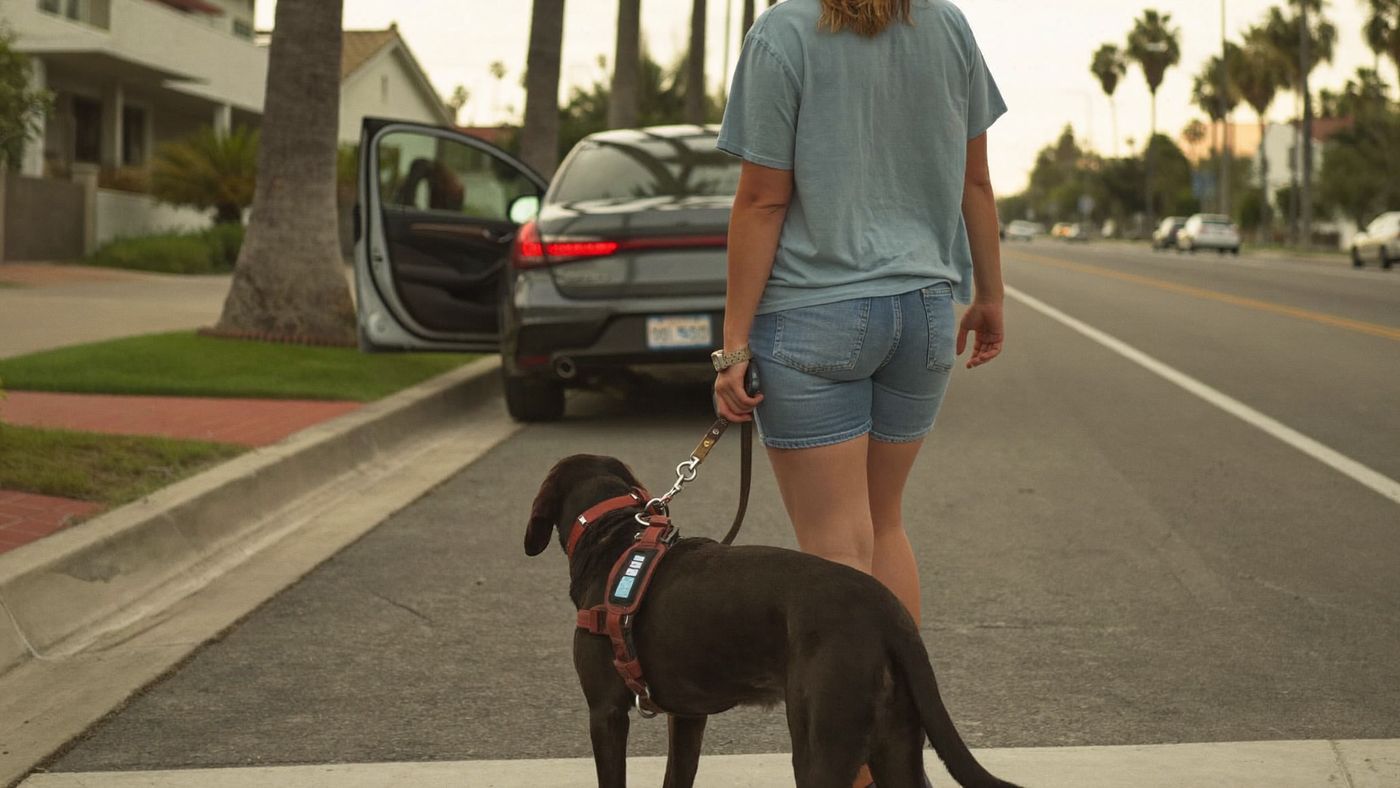
The car pulls up, the driver sees the dog, the car pulls away. Anyone who works a service dog in Palm Beach County eventually collects one of these stories. Federal law and Florida law both treat that refusal as discrimination, and both give you a place to take it. Here is the order of operations, starting with the two minutes right after the car leaves.
First, build the record
Do this on the curb, while it is fresh. Write down the date and time, the exact address or intersection, the company name (Uber, Lyft, or the taxi company on the door), the driver's name and the vehicle or plate number, and the words the driver actually used. Get the names and phone numbers of anyone who saw it. Screenshot the trip in the app: it fixes the date, the driver, the cancellation, and any money that moved.
Money matters here. DOJ's position is that a cleaning fee charged for a service dog's shedding and a cancellation fee charged after an unlawful refusal are themselves ADA violations, not just annoyances. Keep your originals. Agencies get copies.
What the driver was allowed to ask
Exactly two questions: is the dog a service animal required because of a disability, and what work or task has it been trained to perform. No registration papers, no certification, no ID card, no demonstration of the task. ADA.gov is blunt that allergies and fear of dogs are not valid reasons to refuse, and Fla. Stat. 413.08(3)(f) says the same in Florida law. A dog can be excluded only if it is out of control and the handler does not act, or it is not housebroken; Florida adds behavior that poses a direct threat. Under 413.08(3)(c) no deposit or surcharge may be imposed as a condition of the dog riding along.
Door one: the company, same day
Uber. In the app, open the trip and use "I Want To Report A Service Animal Issue" (it is also in the account menu). The service animal line is +1 (833) 715-8237. Uber's policy allows no exceptions for allergies, religious objections, or fear of dogs, says riders never owe cleaning fees for a service animal's hair, and says a cancellation fee charged because of a service denial gets refunded once you report it. Drivers who refuse can lose access to the Driver App.
Lyft. Menu, then Help, then "Lyft ride and payment issues," then under Ride issues pick "Service animal denied," which offers the Service Animal Help Line or chat. The line is 1-844-554-1297. Lyft's driver policy warns of immediate and permanent deactivation when an investigation confirms a wrongful denial.
Can a driver demand papers for my dog?
No. Registration, certification, ID cards and vests are not required under the ADA or Fla. Stat. 413.08(3)(b), and both Uber and Lyft state riders do not have to show proof.
I was charged a cleaning fee for dog hair. Is that legal?
No. Uber's own policy says drivers are not entitled to those fees, and DOJ treats such charges as ADA violations. Report it and ask for the refund.
Does this cover an [emotional support animal](/blog/dog-laws/service-dog-vs-emotional-support-animal-florida)?
Not under 413.08. That statute limits service animals to dogs and miniature horses trained to do work or tasks, and says comfort or companionship is not a task.
Do I have to complain to an agency before suing?
No. Title III lets you file your own case in U.S. District Court, and there is no right-to-sue letter to wait for.
Door two: the federal complaint
File at civilrights.justice.gov. Questions go to the DOJ ADA Information Line, 800-514-0301 (voice) or 1-833-610-1264 (TTY), Monday through Friday; the Civil Rights Division also lists (202) 514-3847, toll free 1-855-856-1247, and TTY 711. Paper complaints go to U.S. Department of Justice, Civil Rights Division, 950 Pennsylvania Avenue NW, Washington, DC 20530.
Include your name, address and phone, the business name, a description of the discriminatory acts with dates, the names of the people involved, and copies of your documents. DOJ says review can take up to three months; if nothing arrives by then, call the information line. On timing, note that ADA.gov publishes a 180-day deadline only for Title II complaints and states no deadline for Title III, which is the part covering private transportation. File early anyway.
This is not a theoretical door. On September 11, 2025 DOJ sued Uber in the Northern District of California over refusals of riders with service dogs and wheelchairs, seeking $125 million for those harmed plus a civil penalty; on March 5, 2026 the court denied Uber's motion to dismiss, and the case is still open. The legal hook is 42 U.S.C. § 12184(a), backed by DOT rules at 49 CFR 37.29(c) and 37.167(d), which require private carriers to let service animals ride.
Door three: state, and the taxi-only local route
The Florida Commission on Human Relations takes public accommodation complaints, free and without a lawyer, within 365 days of the violation (Fla. Stat. 760.11(1)). Reach it at 4075 Esplanade Way, Room 110, Tallahassee, FL 32399, (850) 488-7082 or 1-800-342-8170, [email protected], weekdays 8 to 5, relay 711.
Street taxis and rideshare split here. Every taxi, limousine and shuttle company operating in Palm Beach County must be licensed by County Consumer Affairs, 50 South Military Trail, Suite 201, West Palm Beach, FL 33415, (561) 712-6600, toll free 1-888-852-7362 for Boca, Delray and Glades residents, with an online complaint form. Uber and Lyft are exempt from that licensing and, under Fla. Stat. 627.748(17), are governed exclusively by state law, so no county, city or airport rule reaches them. What state law does say, at 627.748(14), is that a TNC driver must comply with service animal laws and a TNC may not add charges because of a passenger's disability.
What the refusal costs the driver
Under Fla. Stat. 413.08(4), refusing access is a second degree misdemeanor: up to 60 days under 775.082(4)(b), a fine up to $500 under 775.083(1)(e), plus 30 hours of community service for an organization serving people with disabilities, completed within six months. The statute cuts both ways. Knowingly misrepresenting a pet as a service animal carries the same penalty under 413.08(9).
This article is general information about how the process works, not legal advice, and it does not create any attorney relationship. Your facts may change the answer. For guidance on your own refusal, talk to a Florida attorney or call the agencies named above directly.

Discussion
Questions get answered here. Reading is open to everyone.
Every comment is read by an automatic check before it appears. Phone numbers, emails and offers of pet care go to a moderator instead of the page.
Sign in to join the discussion. Reading is open to everyone; posting, replying and voting need an account, which keeps the comments answerable to a real person. Sign in or create an account
- Nobody has said anything yet. If the article left a question open, ask it here and we will answer.