
Witnessing a crime with a big dog: what Florida law says
· 39 views
We are not lawyers and this is not legal advice. What follows is a plain reading of published Florida statutes, with links so you can read them yourself, and practical guidance from how these situations actually unfold. If you are facing a real incident, talk to an attorney. We walk dogs for a living, and this article exists because clients keep asking the same question.
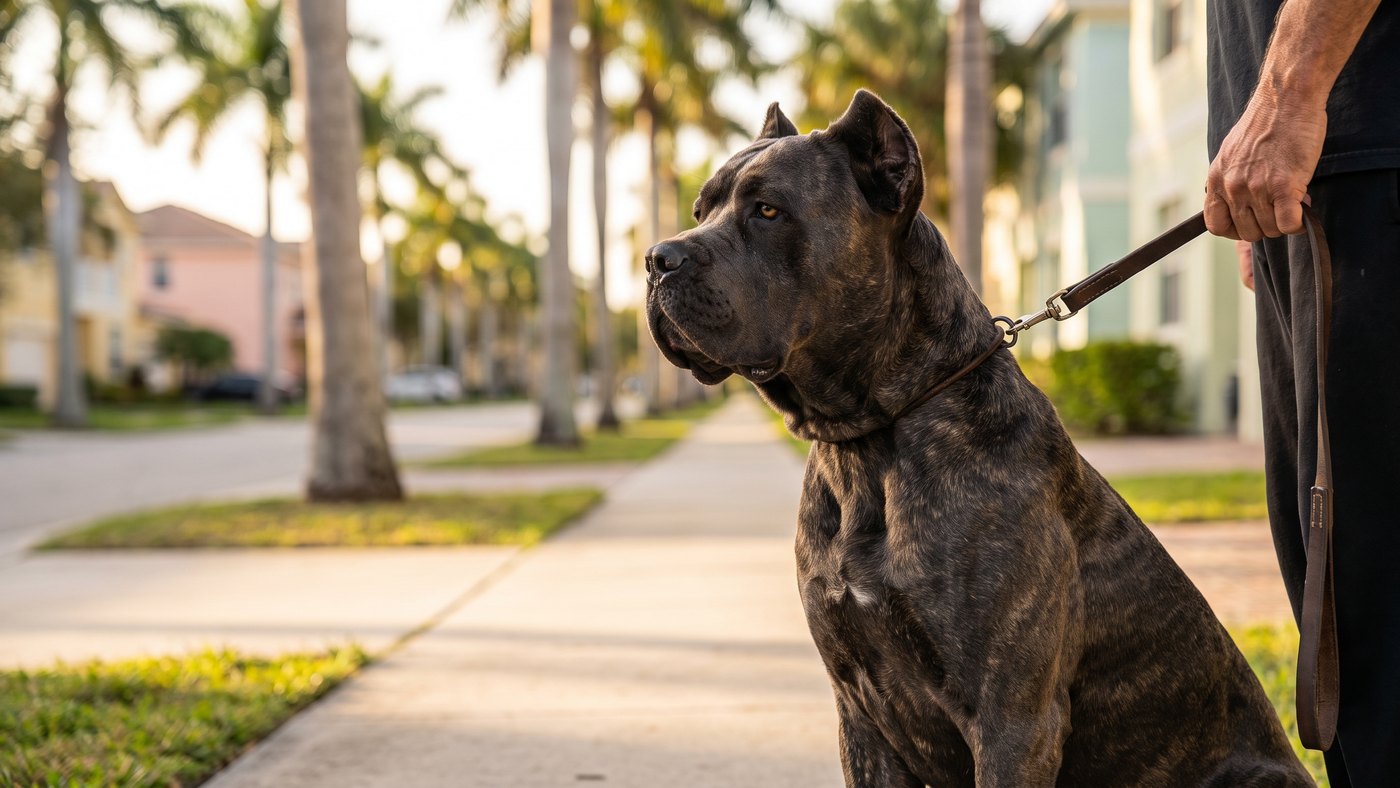
The question goes like this. You are out with your dog, the big one, the one people cross the street to avoid. Something happens in front of you: a bag snatched, a car window broken, someone shoving someone else. Your dog is watching it too, and every instinct you have says do something.
Should you let the dog go?
Florida law answers this more clearly than most people expect, and the answer is no. What is interesting is where exactly the law draws the line, because it is not where most owners imagine.
The statute already drew the line
Florida has a mechanism for declaring a dog dangerous, and once that classification lands the animal's life changes permanently.
Section 767.11 defines a dangerous dog as one that, according to the records of the appropriate authority:
(a) Has aggressively bitten, attacked, or endangered or has inflicted severe injury on a human being on public or private property; (b) Has more than once severely injured or killed a domestic animal while off the owner's property; or (c) Has, when unprovoked, chased or approached a person upon the streets, sidewalks, or any public grounds in a menacing fashion or apparent attitude of attack, provided that such actions are attested to in a sworn statement by one or more persons and dutifully investigated by the appropriate authority.
Read clause (c) again. Chasing or approaching a person on a public sidewalk in a menacing fashion is enough. No bite is required. One sworn statement starts the process.
Then section 767.12 sets out when that classification cannot be applied, and this is the most important passage in the article:
(2) A dog may not be declared dangerous if: (a) The threat, injury, or damage was sustained by a person who, at the time, was unlawfully on the property or who, while lawfully on the property, was tormenting, abusing, or assaulting the dog or its owner or a family member. (b) The dog was protecting or defending a human being within the immediate vicinity of the dog from an unjustified attack or assault.
Two shields, and both of them are narrow in a specific way.
Exception (a) is about property. Someone who is on the property unlawfully, or who is on it lawfully but is attacking you, your family or the dog, does not get a dangerous dog classification out of what follows.
Exception (b) is the general one, and every phrase in it is load-bearing. Protecting or defending a human being. Within the immediate vicinity of the dog. From an unjustified attack or assault.
A dog that puts itself between you and someone attacking you, right there, is covered. A dog sent across a parking lot after a man running away with a handbag is covered by neither exception. It is not on your property, nobody is being attacked, and nobody is in the dog's immediate vicinity. The protection the statute offers simply does not reach that far.
What sending the dog actually is, legally
Under Florida law a deadly weapon is any object used in a way likely to produce death or great bodily harm, and the category is not limited to obvious things. Prosecutors have treated dogs as deadly weapons when an owner directed the animal to attack. Aggravated assault and aggravated battery are felonies.
So the act you are contemplating, in the moment when it feels most justified, is the act most likely to move you from witness to defendant. You would be introducing force into a situation you were not part of, using an instrument the law can classify as a weapon, against a person whose guilt has not been established by anyone but you.
And you would be doing it in a jurisdiction where the person you released the dog on can sue you.
Strict liability does not care who the person was
Section 767.04 is the one that surprises owners:
The owner of any dog that bites any person while such person is on or in a public place, or lawfully on or in a private place, including the property of the owner of the dog, is liable for damages suffered by persons bitten, regardless of the former viciousness of the dog or the owners' knowledge of such viciousness.
There is no exception in that sentence for people committing crimes. A person on a public sidewalk is in a public place, whatever they were doing thirty seconds earlier. The statute reduces the owner's liability in proportion to any negligence by the person bitten, which matters, but reduced is not zero.
The picture on private property is different, and section 767.04 also addresses the case of a person not lawfully present. That is a genuinely different situation from a public street, and it is exactly the kind of distinction worth taking to an actual attorney rather than reading off a blog.
What happens to the dog
This is the part owners think about last and should think about first.
If animal control classifies a dog as dangerous, the consequences run for the rest of the animal's life. Registration with the animal control authority, renewed every year. A muzzle and a substantial leash any time the dog is outside a proper enclosure. Liability insurance of at least one hundred thousand dollars. A dog under investigation for severe injury to a human being can be confiscated and impounded immediately, before anything is decided.
If you appeal, the dog is held during the appeal and you pay the boarding. And if a dog already classified as dangerous bites again without provocation, the owner is committing a first degree misdemeanor.
Weigh that against the outcome you were imagining, which was a stranger's stolen handbag being recovered.
Should you get involved at all?
Here is the honest framing, and it is not the heroic one.
You have no general legal duty to intervene in a crime you witness. There are narrow exceptions in the law around assisting an officer who asks for help, and there are mandatory reporting duties in specific contexts such as suspected child abuse. Walking past a robbery is not a crime in Florida.
That leaves it as an ethical question, and the ethical answer is not "do nothing." It is that the useful thing you can do and the dramatic thing you want to do are different actions.
Consider what you are actually holding. A leash, attached to an animal that reads your adrenaline before you have finished producing it, in a public place with bystanders, near traffic. Your dog does not know which person is the criminal. It knows that you are frightened and that something is happening. Dogs in that state bite the wrong person with some regularity, and the wrong person is often the one trying to help.
What actually helps
Distance first, and take the dog with you. Move away from the incident, put a car or a corner between you and it, and shorten the leash. This is not cowardice, it is removing two variables, you and the dog, from a situation that already has too many.
Call 911 and stay on the line. The dispatcher wants location before anything else. Then direction of travel, then a description that survives being repeated over a radio: clothing colors from the top down, build, anything carried, vehicle color and type and partial plate. Not "he looked suspicious." Colors, numbers, direction.
Be a witness that holds up. Write down what you saw as soon as it is over, on your phone, in your own words, with the time. Memory degrades fastest in the first hour and a contemporaneous note is worth more later than a confident recollection.
Film only if you can do it from safety and with both hands free of the leash. A video from behind a car is evidence. A video taken at ten feet with a large dog on a loose leash is two problems.
Do not chase. Not with the dog, not without it. Pursuing turns a witness into a participant, and there is no version where a running dog and a running human end well in a parking lot.
The one situation where the law is with you
If someone attacks you, that is a different article and a different statute. That is the case the exception in 767.12 was written for: a dog defending a human being in its immediate vicinity from an unjustified assault.
Even there, understand what follows. There will be an investigation. Animal control will look at your dog. What protects the animal is the fact pattern, that it was defending a person under attack, and fact patterns are established by evidence: 911 recordings, witnesses, cameras, your own account given early and consistently. Call the police yourself, immediately, even if you were the one attacked. The person who calls first is the person whose account frames the incident.
What to do before any of this happens
The preparation that matters is unglamorous.
A recall that works under stress. Not a recall that works in the kitchen with a treat. A dog that comes back through excitement is a dog you can extract from anything.
A reliable "leave it" and a reliable settle. These are the commands that do real work in a crisis, and neither of them involves the dog approaching anyone.
Know your leash. A retractable lead is not a control device in an emergency. A fixed lead of a few feet, held properly with the loop around the wrist, is.
Know your dog honestly. Not what breed people think it is, but what it does when a stranger shouts nearby. If the answer is that you are not certain, that is the answer, and it means the dog goes further away from trouble, not closer.
We spend our days on the other end of leashes attached to large dogs in public places, and the working truth is this: the best outcome in almost every incident is that the dog never becomes part of the story. A dog that stayed calm and out of the way is not a missed opportunity. It is the whole job done correctly.
Once more, because it matters: we are not attorneys. The statutes are linked above and they are short. Read them. If something has already happened, call a lawyer before you call anyone else.
Discussion
Questions get answered here. Reading is open to everyone.
Every comment is read by an automatic check before it appears. Phone numbers, emails and offers of pet care go to a moderator instead of the page.
Sign in to join the discussion. Reading is open to everyone; posting, replying and voting need an account, which keeps the comments answerable to a real person. Sign in or create an account
- Nobody has said anything yet. If the article left a question open, ask it here and we will answer.