
Flying to Europe with a dog or cat from Florida: 2026 rules
· 35 views
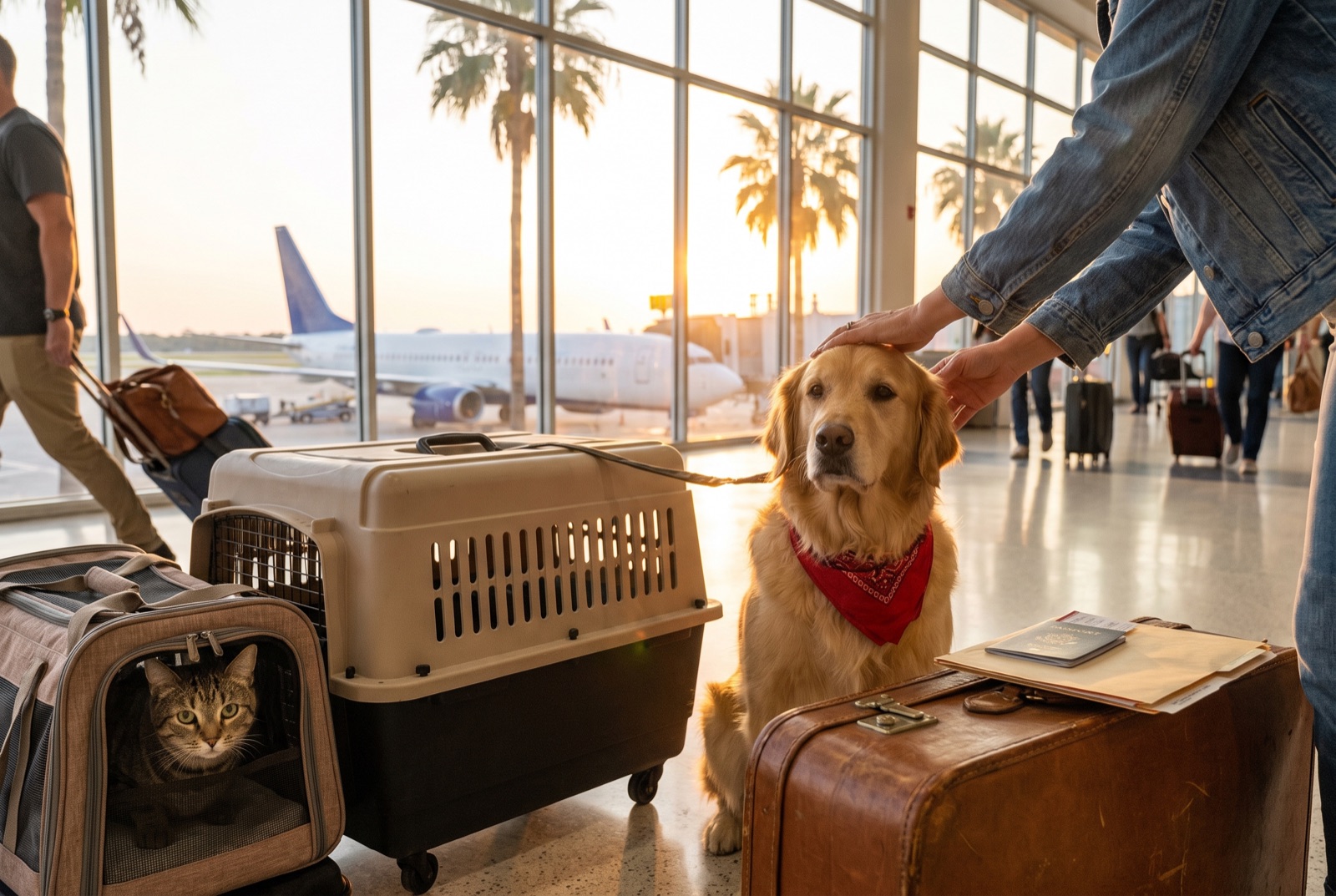
Trips to Europe with a pet almost never fall apart at the airport. They fall apart weeks earlier, in a veterinary office in Boca Raton or West Palm Beach, because two ordinary things were done in the wrong order.
The rules are not complicated. They are sequential, and the sequence is unforgiving. Get it right and the paperwork is a morning's work. Get it backwards and the fix is a new rabies vaccination and a new three week wait, which is how a summer trip becomes a fall trip.
Here is the order, what changed this April, and what our three local airports can and cannot do.
The order is the whole thing
One: the microchip goes in first. It has to be an ISO 11784 or 11785 chip, the fifteen digit kind. This is not a formality. The EU rule is that the vaccination date cannot precede the microchip identification date. A dog vaccinated in March and chipped in April has, as far as Europe is concerned, no valid rabies vaccination at all. The vaccination has to be given again, after the chip.
If your pet was chipped years ago, ask your vet to scan it before anything else. Older chips sold in the United States are sometimes not ISO compliant, and a chip a European officer's reader cannot read is the same as no chip.
Two: the rabies vaccination. The animal must be at least twelve weeks old when it is given.
Three: wait twenty one days. The certificate's validity period starts a minimum of twenty one days after the primary vaccination is completed. Some vaccine manufacturers suggest waiting thirty. Nobody has ever regretted the extra nine days.
The arithmetic is worth doing out loud: twelve weeks plus twenty one days puts the earliest realistic arrival at around fifteen weeks of age. If you are moving with a puppy or kitten younger than that, there is a separate and narrower set of conditions and you should start with the USDA's page on young pets rather than this article.
Four: the health certificate. A USDA accredited veterinarian completes, signs and dates it. Then the USDA endorses it, which means countersigning and stamping. Both steps, in that order, every time.
Five: arrive within ten days. The certificate is valid for ten days from the date it is issued, and that clock runs to the border check, not to your departure. After you are in, it covers onward movement inside the EU: the European Commission currently gives six months or until the rabies vaccination expires, whichever comes first, while some national veterinary services still publish the older four months. Check the country you are actually flying into.
What changed in April 2026
On 22 April 2026, Regulation (EU) 2026/131 replaced the 2013 rules that most travel guides are still quoting. Two things matter to someone flying out of South Florida.
The first is good news that has not changed: there is no rabies antibody titration test for pets coming from the United States. The blood test, the three month wait, the laboratory approval, none of it applies to you. If a website tells you otherwise, it is describing a different kind of country.
The second is a correction people keep getting wrong. The EU pet passport is a document for residents of EU member states. A traveller coming from the United States needs an EU animal health certificate for each trip, not a passport. Passports issued before the new rules stay valid on their own terms, with a transition running into 2028, but that is a rule about existing European passports, not a door into getting one here.
Where you are allowed to land
This is the part almost nobody plans for.
You cannot simply arrive anywhere. Germany's federal ministry puts it plainly: you may only arrive with dogs, cats and ferrets from a third country via authorised entry points. Every EU country designates its own, and the major intercontinental airports are on the list, but a charming regional airport may not be.
At that entry point there are three checks: an identity check of the animal, which means scanning the chip and matching the number to your paperwork, a document check, and a check that the travel conditions were actually met. Build time for it. A ninety minute connection in an unfamiliar terminal with an animal and a folder of documents is not a plan, it is a hope.
Non commercial movement is capped at five animals in one vehicle. Above that you are in commercial rules, which is a different certificate and a different article.
Getting it done from Boca Raton or West Palm Beach
The paperwork has one local constraint, and it is not geography. Both Palm Beach County and north Broward have plenty of veterinarians. The constraint is that the certificate must be issued by a USDA accredited veterinarian, and not every clinic has one on staff.
Ask the question directly when you call, before you book anything: is there a USDA accredited veterinarian here who does EU export certificates? A practice that does them regularly will answer in one sentence. A practice that has never done one will take three weeks to find out.
Then plan backwards from the flight, because the ten day window squeezes everything. The examination, the certificate and the USDA endorsement all have to land inside those ten days, and endorsement is not instant. Ask your clinic how they submit and how long it usually takes them, then book the appointment against that answer rather than against the calendar in your head.
One more local detail worth knowing: your certificate travels with you, not in the hold. Keep the original in your carry on, with the rabies certificate and the microchip record, and keep photographs of all of it on your phone.
Five places that want a dewormer, and one that surprises people
Finland, Ireland, Malta, Northern Ireland and Norway require a tapeworm treatment against Echinococcus multilocularis. Three details decide whether you comply:
- It is for dogs only. Not cats, not ferrets.
- It must be given by a veterinarian and recorded, not bought over a counter.
- The window is narrow: not more than 120 hours and not less than 24 hours before the scheduled time of entry. That is between one and five days, and it is counted to arrival, not to takeoff.
The trap is routing. A dog flying to Spain needs no treatment. The same dog flying to Spain through Dublin, if the itinerary puts it into Ireland rather than through an airside transit, may need one. Ask before you book, not after.
Great Britain is not the European Union
If your trip is London rather than Lisbon, you are reading a different rulebook, and it is stricter in one specific way.
The UK government's requirements are that the pet must be microchipped before it gets its rabies vaccination, that you wait at least twenty one full days after the first vaccination, and that a dog must be treated for tapeworm no less than 24 hours and no more than 5 days before you arrive in Great Britain. So Britain wants the dewormer where most of continental Europe does not.
The UK also requires that your route be an approved one. In practice this shapes the whole trip: for most people flying in from the United States it means the animal travels as manifest cargo on an approved route rather than under the seat. A London trip and a Frankfurt trip with the same dog are two different projects with two different budgets.
How a pet actually crosses the Atlantic
There are three ways, and you do not get to choose which one applies to you.
In the cabin. Small animals in a soft carrier that fits under the seat in front of you. The limit that matters is the combined weight of the animal and the carrier, and that single line is why most dogs never qualify. Cabin places are also capped per flight, so the pet is a booking of its own, made when you book yourself and not the week before.
As checked baggage. The animal flies in a heated, pressurised hold on your flight, checked in with you.
As air cargo. A separate booking, often through a pet shipping agent, sometimes on a different aircraft than yours.
What people from Florida get wrong is assuming that a domestic experience transfers. It does not. Long haul international is the narrowest part of every airline's pet policy: some carriers exclude in cabin pets on transatlantic routes entirely, and several have suspended their hold and cargo programmes except for military and government relocations. Two airlines at the same Miami gate can have completely different answers.
So before you buy a ticket, open your airline's own pet page and read it for your specific route. Then call and confirm the animal is booked, not just permitted. Four things to raise on that call:
- The crate standard. Airlines work to the IATA Live Animals Regulations. Buy the crate early, put it in the living room, feed the animal in it for weeks. A crate first met at the airport is a bad introduction to a nine hour flight.
- Flat faced breeds. Many carriers will not take snub nosed dogs and cats in the hold at all. If you have a French bulldog, a pug, a Boston terrier or a Persian, this decides your trip before anything else does, and it is worth understanding why those breeds struggle in the first place.
- Sedation. Do not. American Airlines, citing the American Veterinary Medical Association, does not accept sedated or tranquillised pets, because sedatives raise the risk of respiratory and cardiovascular problems at altitude.
- The connection. A connecting itinerary can put the animal on a second airline with different rules and a different container standard. One booking does not mean one policy.
Three airports, one honest answer
Miami International is South Florida's transatlantic gateway, and it is also the best equipped for animals. There are indoor relief areas past security in Concourses D, F, G and J, enclosed units with synthetic grass, a hydrant, bags and a sink, plus outdoor areas at arrival level in Concourses D, E and J. Being able to walk a dog without leaving and re clearing security is worth more on a long connection than any lounge.
Fort Lauderdale Hollywood International has six service animal relief areas past security, three of them in Terminal 1 and one each in Terminals 2, 3 and 4, with pet relief areas outside the terminals on the lower level.
The West Palm Beach airport, long known as Palm Beach International, now presents itself as President Donald J. Trump International Airport and uses the code DJT on its own site, which keeps a name change FAQ. For pet owners the practical fact is unchanged and specific: its international nonstops are the Bahamas and Canada. There is no nonstop Europe. Its outdoor pet relief areas sit at the east and west ends of the terminal on Level 1, fenced, shaded, with wood chips, grass and free bags.
Which leads to the honest answer for anyone in Palm Beach County: your European trip with a pet begins with a connection. That connection is the single most fragile part of the plan, because it is where a second airline, a second aircraft type and a second set of animal rules enter the picture. If the trip is happening, the drive to Miami is usually the better start, and if you are making that drive in July, our piece on what a parked car does in Florida heat applies to the airport garage too.
If it is a cat
Cats get the easier half of the rules and the harder half of the experience.
On paper they are simpler: same chip, same vaccination, same twenty one days, same certificate, same ten day window, and no tapeworm requirement anywhere. A cat can skip the dewormer even where a dog cannot.
In practice the carrier is the whole project. A cat that has only ever entered a carrier on the way to a veterinarian has learned exactly one thing about carriers. Leave it open on the floor for weeks with a blanket that smells like home. Feed in it. Close the door for five minutes, then twenty, then an hour.
Two practical points for the checkpoint. First, plan for the moment the carrier goes through the X ray without the animal in it, and put a well fitted harness and leash on the cat before you get in line, because a startled cat in an open terminal is a genuinely serious problem. Second, line the carrier with an absorbent pad and pack two spares, a plastic bag and gloves. Nine hours is a long time.
If it is a dog
Crate first, everything else second. If the dog is flying in the hold, the crate is where it lives for the whole trip, and familiarity with it is the single biggest thing you control.
Label the crate with your name, both phone numbers and the destination address. Freeze water in the crate's bowl before check in so it melts slowly instead of spilling at pushback. Walk the dog properly before you leave for the airport, then again at the relief area. Skip the food close to departure, and confirm the feeding instructions the airline wants attached.
And be honest about the dog you have. A nervous, reactive or elderly dog is not the same traveller as a calm three year old retriever, and there is no shame in deciding that the flight is not for this animal. Which brings us to the option most people never seriously price out.
Or leave them home, and actually see them every day
Here is the thing nobody selling pet shipping will tell you: for a two or three week trip to Europe, the flight is usually the worst option available to your animal. Not the most expensive, though it often is. The worst.
Two flights, two holds, a strange crate, a language change, and a rulebook that treats your dog as a consignment. Against that: the same bed, the same couch, the same street, and the same person coming through the door every day.
For most people leaving Palm Beach County for two or three weeks, the real decision is not which airline takes pets. It is whether to book a pet sitter in Boca Raton or West Palm Beach and leave the animal where it already lives.
dogoboca does overnight in home pet sitting across Palm Beach County and north Broward. Your pet stays in your house. The sitter comes to them, on your schedule, and it is the same sitter for the whole trip rather than whoever is free that day. You can see what we cover and what it costs in Boca Raton and in West Palm Beach.
The part that matters when you are six time zones away is the reporting. Every visit lands in your personal account: arrival marked with a photo, what was fed, how the walk went, medication given, and pictures. You open your account over breakfast in Rome and see exactly how last night went. No wondering, no chasing anyone on WhatsApp.
Call (754) 444-0758, or request a free meet and greet, before you book anything. Twenty minutes, no card on file. You meet the person who would actually be staying with your animal, and they meet your locks, your alarm, your cat who hides under the bed.
If your address is in one of these Boca Raton ZIP codes, you are inside or right beside our zone: 33428, 33431, 33432, 33433, 33434, 33486, 33487, 33496, 33498. In West Palm Beach our zone covers 33401, 33403, 33405, 33406, 33407, 33409 and 33411, and we also serve Highland Beach, Delray Beach and Gulf Stream, Boynton Beach, Ocean Ridge and Briny Breezes, and Pompano Beach, Lighthouse Point, Hillsboro Beach and Deerfield Beach in north Broward.
Not sure whether your street is in the zone? Call and ask. We will tell you straight, and if we do not cover you yet we will say so.
We are a pet care company. We are not veterinarians, not attorneys and not a licensed pet transport agent. Everything above links to the government sources it came from so you can read them yourself, but nothing here is medical, legal or customs advice, and no article can account for your animal, your airline or your destination. Rules for pet movement change, and airline policies change faster than governments do. Confirm every requirement with the USDA, with the veterinary authority of the country you are entering and with your airline before you book. If you are unsure, use a licensed pet relocation agent.
FAQ
What do I need to take a dog from Florida to the European Union?
An ISO microchip implanted before the rabies vaccination, a rabies vaccination given at twelve weeks or older and at least twenty one days before arrival, and an EU animal health certificate completed by a USDA accredited veterinarian and endorsed by the USDA. You must arrive within ten days of the certificate being issued.
Does my pet need a rabies blood test to enter Europe from the United States?
No. The European Commission states that the rabies antibody titration test is not required for animals coming from the United States. That test applies to other countries.
In what order do the microchip and the rabies shot have to happen?
Microchip first, always. The EU does not accept a rabies vaccination given before the chip was implanted. If the order was wrong, the vaccination has to be repeated after chipping and the twenty one day wait starts again.
Which European countries require a tapeworm treatment?
Finland, Ireland, Malta, Northern Ireland and Norway, plus Great Britain under its own rules. It applies to dogs only, not cats, and must be given by a veterinarian between 24 and 120 hours before arrival.
Are the rules for the United Kingdom different from the EU?
Yes. Great Britain has its own requirements, including a tapeworm treatment for dogs no less than 24 hours and no more than 5 days before arrival, and travel on an approved route. Check gov.uk separately from the EU rules.
Do I need a pet passport to take my dog to Europe?
No, and you cannot get one here. The EU pet passport is a document for residents of EU member states. Travelling from the United States you need an EU animal health certificate, issued by a USDA accredited veterinarian and endorsed by the USDA, for each trip.
Where do I get an EU health certificate near Boca Raton or West Palm Beach?
From any USDA accredited veterinarian, then endorsed by the USDA. Not every clinic has an accredited vet on staff, so ask specifically whether they do EU export certificates before you book, and plan the appointment inside the ten day window before your flight.
Can I fly to Europe with my cat in the cabin?
Sometimes, depending on the airline, the route and the combined weight of the cat and carrier. In cabin allowances on transatlantic flights are narrower than on domestic ones, and some carriers do not permit pets in the cabin on those routes at all. Confirm with the airline for your specific flight before booking.
Are there nonstop flights to Europe from the West Palm Beach airport?
No. The airport's own site lists the Bahamas and Canada as its international nonstop destinations. A trip to Europe with a pet from Palm Beach County starts with a connection, most often through Miami.
What can I do instead of flying my pet to Europe?
For most trips of two or three weeks, leaving the animal at home with a sitter is easier on the pet and cheaper than transatlantic pet transport. dogoboca does overnight in home sitting across Palm Beach County with the same sitter each visit and a report with photos in your personal account after every visit. Call (754) 444-0758 for a free meet and greet.


Discussion
Questions get answered here. Reading is open to everyone.
Every comment is read by an automatic check before it appears. Phone numbers, emails and offers of pet care go to a moderator instead of the page.
Sign in to join the discussion. Reading is open to everyone; posting, replying and voting need an account, which keeps the comments answerable to a real person. Sign in or create an account
- Nobody has said anything yet. If the article left a question open, ask it here and we will answer.