
Dogs and cats in cars: convertibles, windows, Florida heat
· 52 views
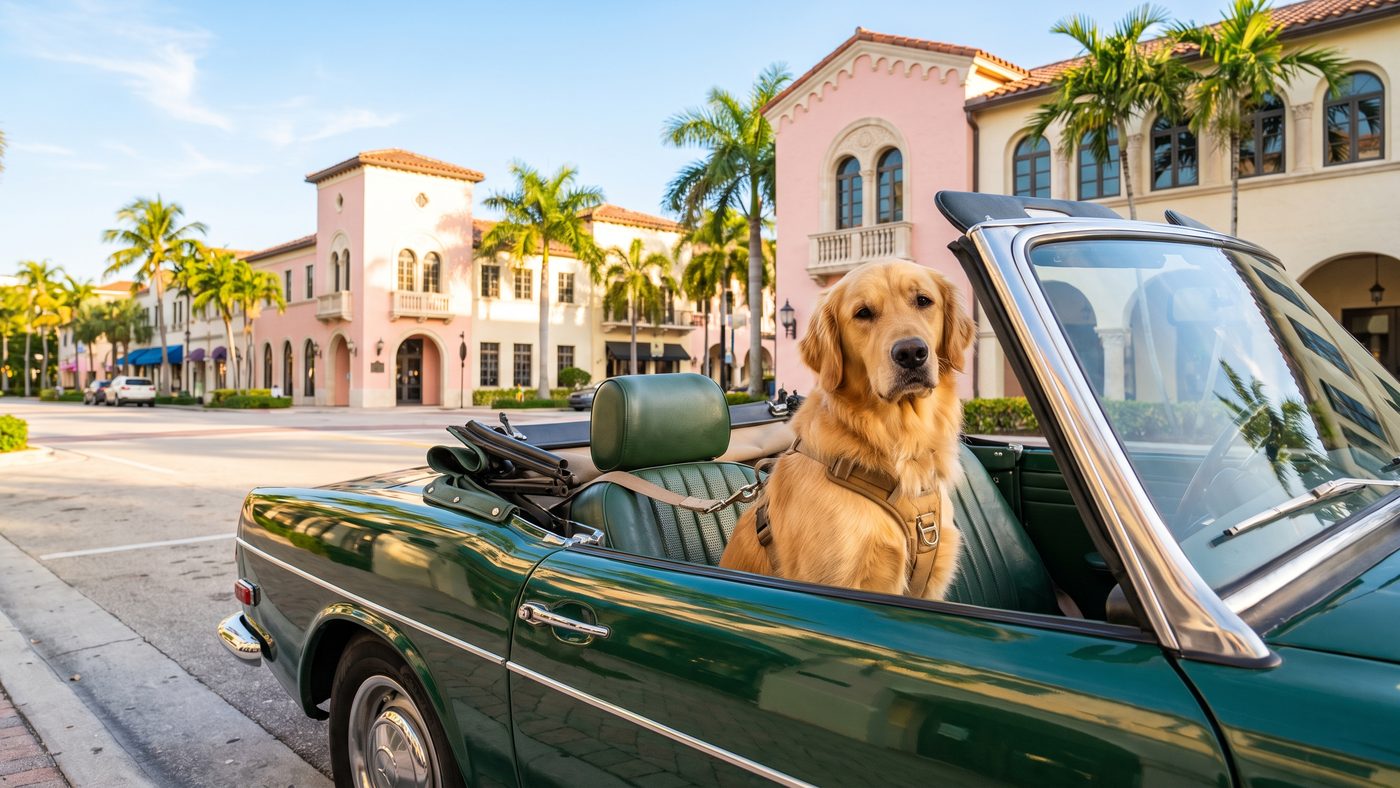
The question that started this article came from a client with a convertible: is it better or worse to drive the dog with the top down? It turns out nobody official has ever answered it, and the answer that matters most in Boca Raton is not in a veterinary guideline at all. It is in the county code, and almost nobody has read it.
Here is what we found, in the order that will actually change what you do.
First, the honest correction
If you have read anything about dogs and heat, you have read about the parked car. It deserves the attention. It is also not where most heat emergencies come from.
A 2020 study in the journal Animals looked at heat-related illness in dogs in the UK and sorted the cases by trigger. Exertion accounted for 74.2 percent of events, environmental heat for 12.9 percent, and confinement in a vehicle for 5.2 percent. The dog most likely to overheat in Florida is not the one in the parking lot. It is the one on a walk at two in the afternoon, and we have written about what that looks like in a Florida summer.
We are telling you this first because it is true, and because the car case has one quality nothing else on the list has: it is entirely preventable by one decision, made before you leave the house.
What a closed car actually does
The measurements everyone quotes come from a 2005 study in Pediatrics by McLaren, Null and Quinn. Sixteen cloudless days, a dark sedan, temperature logged every five minutes for an hour.
Two findings matter. The first is the speed: the interior gained an average of 3.2 degrees Fahrenheit every five minutes, and 80 percent of the total rise happened in the first 30 minutes. The second is the one that surprises people: even on the coolest day they tested, with an outside temperature of 72 degrees, the inside of the car reached 117.
The third finding is the one worth arguing about with a stranger in a parking lot. Cracking the windows does not work. In the study's own words, leaving the windows opened slightly "does not significantly slow the heating process or decrease the maximum temperature attained." The American Veterinary Medical Association puts it in three words: cracking the windows makes no difference.
The AVMA publishes a table of estimated interior temperatures, credited to meteorologist Jan Null. It is a model rather than a set of measurements, so read it as a forecast, not a thermometer reading:
- Outside 80, inside after 10 minutes: 99. After 30 minutes: 114. After an hour: 123.
- Outside 90, inside after 10 minutes: 109. After 30 minutes: 124. After an hour: 133.
Now put a Florida number next to it. At Palm Beach International, the nearest official weather station to us, the 1991 to 2020 average daily high is 88.3 in June, 90.0 in July, 89.9 in August and 88.0 in September. That is the average, not the hot day. The National Weather Service in Miami puts our summer season at a median of 152 days.
So the 90 degree row of that table is not an extreme case here. It is most of the summer.
The part of the car nobody measures
Air temperature is only half of it. In 2018 researchers in Arizona parked three types of car in the sun and measured the surfaces. After an hour, the average dashboard read 156 degrees Fahrenheit, the steering wheel 128 and the seat 123. The hottest single dashboard reading was 185. The National Weather Service independently describes dark dashboards and seats reaching 180 to over 200.
A dog does not sit on the dashboard. A cat carrier does, sometimes, and a dog lies on the seat. Those numbers are why a car that has been "only ten minutes in the sun" is not a neutral place even with the engine running and the air on.
Convertibles: what is actually known
Here is the honest state of the evidence: no veterinary body has published guidance on convertibles. Not the AVMA, not the AKC, not the ASPCA, not the American Animal Hospital Association. We looked. The word does not appear in their pet travel materials.
That absence is itself worth knowing, because it means anyone telling you that "vets say convertibles are fine" or "vets say never" is making it up. What we can do is put together the things that are documented.
The heat problem changes shape rather than disappearing. Moving with the top down, the dog is not in a sealed box, so the runaway greenhouse effect does not apply. Parked with the top down, you have removed the greenhouse and replaced it with direct sun on the seats and on the dog. Neither version makes an unattended stop acceptable, and the second one adds sunburn to the list.
Sunburn is real and breed specific. The AKC names the vulnerable areas: the bridge of the nose, ear tips, the skin around the lips, the groin and the inner thighs. Thin coats, white coats and pink skin burn fastest. If you use a sunscreen made for dogs, the AKC warns it must not contain zinc oxide or para-aminobenzoic acid, both of which are toxic if licked off.
The wind is not free. The AVMA is specific about riding with the head outside the window: airborne dirt and debris can injure the eyes, ears, nose and mouth. Cornell's canine health center adds the blunt version, that a dog can be thrown from the vehicle. In an open car the whole cabin is the window.
Two states legislated exactly this vehicle. Maine defines an "open vehicle" as one with a portion not enclosed by a top and windows or sides, and requires the dog to be secured against falling, jumping or being thrown out. Rhode Island uses "open air motor vehicle" and requires restraint by something other than a neck collar. Florida has no such statute. Our county, as you are about to read, effectively does.
The practical answer to the client's question: a convertible is fine to drive in with a properly restrained dog, in the cooler part of the day, with the dog inside the cabin and not hanging over the door. It is a bad place to leave anyone, and a worse place to park in the sun than a closed car with the air running, because there is no shade at all.
The rule that actually applies in Boca Raton
This is the section we most want you to keep.
Florida has no state law that prohibits leaving an animal in a parked car. People assume there is one. There is a cruelty statute, section 828.12, which covers carrying an animal "in or upon any vehicle, or otherwise, in a cruel or inhumane manner," and that is a first degree misdemeanor. But there is no plain rule naming the parked car. Twenty six states have one. Florida is not among them.
Palm Beach County wrote its own, and it is stricter than most of those states. Chapter 4, section 4-24 of the county code makes it unlawful to:
- leave an animal in any unattended motor vehicle;
- transport an animal without adequate ventilation or in unsanitary conditions;
- subject an animal to extreme temperatures that adversely affect its health or safety.
The same section requires that any animal transported on a public road be "safely and humanely restrained (at a minimum by a harness with double tethering for dogs) so that the animal is unable to jump or fall out of the vehicle," and that a crate be secured against movement. If the vehicle has a metal truck bed, the animal must be protected from the metal.
Read that restraint clause next to a convertible and the question answers itself. The ordinance applies across both the incorporated and unincorporated parts of the county, which includes Boca Raton, Delray Beach, Boynton Beach and West Palm Beach. Palm Beach County Animal Care and Control is at (561) 233-1200.
Pompano Beach and Deerfield Beach sit in Broward County and are outside this particular ordinance, which is exactly the kind of detail worth checking rather than assuming.
If you are the person in the parking lot
Florida does protect a bystander who breaks into a car to rescue an animal, but the protection is narrow and conditional. Section 768.139 gives immunity from civil liability for the damage to the vehicle, and only if all five of these are true:
- The vehicle is locked, or there is otherwise no reasonable way for the animal to get out.
- You have a good faith and reasonable belief that entry is necessary because the animal is in imminent danger of harm.
- Law enforcement is notified, or 911 is called, before you enter or immediately after.
- You use no more force than necessary.
- You stay with the animal in a safe place near the vehicle until a first responder arrives.
Note what that immunity does not cover: anything other than the damage to the car. Call first. The call is also what creates the record.
Restraint, and one number you should stop repeating
Everyone quotes it: an unrestrained ten pound dog in a 30 mile per hour crash "becomes a 300 pound projectile." We went looking for the study behind it. There isn't one. The figure comes from a 2010 AAA press release quoting a staff member, alongside a survey about driving habits, and it was produced by multiplying weight by speed. Pounds times miles per hour is not a unit of force, and different versions of the claim use multipliers of 20, 30 and 45 for the same scenario.
The real case for restraint does not need an invented number. The AVMA's position is that it is unsafe for pets to be loose inside motor vehicles, and its advice is a secure harness or a carrier. The ASPCA says a crate is the safest option in a crash.
If you want to know whether the harness you own is any good, the Center for Pet Safety is the only group crash testing this equipment. Their findings are sobering and often misquoted: in their harness study of eleven brands, they named exactly one Top Performer, and they explicitly refused to issue pass or fail grades at all. They now run a certification program, and the certified list is short. Short is the point.
Cats travel differently
Almost everything above assumes a dog. Cats need their own paragraph.
The AVMA's instruction is to confine cats to a carrier, which prevents them crawling under the driver's feet and escaping when a door opens. The feline veterinary association goes further on placement: secure the carrier on the floor of the vehicle behind the driver or passenger seat, and if you are using a seat belt to hold a carrier, use it only with carriers that are crash tested, because a belt can crush one that is not built for it. Covering the carrier gives the cat somewhere to hide, which is the single cheapest way to lower the stress of the trip.
A carrier with both a top and a front opening, or one that comes apart in the middle, will also change your relationship with the vet visit. Being lifted out through the top beats being poured out of the front.
Flat faced pets, and why the rules are stricter for them
Pugs, French and English bulldogs, Boston terriers, Pekingese and Persian cats share an anatomy that makes cooling harder. Panting is how a dog sheds heat, and brachycephalic airway syndrome compromises exactly that.
The numbers are stark. In a 2020 study of more than 900,000 dogs, brachycephalic breeds had roughly twice the odds of heat related illness compared with medium muzzled breeds. Compared against Labradors, the odds ratios ran to 13.95 for the bulldog and 6.49 for the French bulldog. Of the dogs in that study that developed heat illness, 14 percent died.
For these breeds, "we will only be a few minutes" is not a smaller risk than for other dogs. It is a larger one.
The short version, for a Florida summer
- Nobody stays in a parked car, ever, for any length of time. In Palm Beach County it is not only unwise, it is against the county code.
- Cracked windows do nothing. This is measured, not opinion.
- Restrain everyone: harness clipped to the belt for dogs, carrier on the floor behind a seat for cats. The county requires restraint on public roads anyway.
- Keep heads inside. In a convertible, keep the dog inside the cabin.
- Cool the car before the pet gets in, and check the seat with your hand before your dog lies on it. If the dashboard is at 156, the seat is not far behind.
- Drive early or late. The same rule that governs walking here governs driving.
- Flat faced pets get the strictest version of all of the above.
We are a pet care company, not veterinarians and not attorneys. Everything above points at published sources so you can read them yourself, but nothing here is medical or legal advice, and no article can account for your pet or your situation. If your pet is overheating, this is an emergency: call your veterinarian or the nearest emergency clinic immediately. For questions about the county ordinance, Palm Beach County Animal Care and Control is at (561) 233-1200.
Too hot to drive anywhere? That is what we are for
The reason this article exists is that most of the driving people do with a dog in August is not a road trip. It is a trip to the park because the dog has been alone since morning and needs to move.
You do not have to make that trip. dogoboca walks dogs across Boca Raton, in the cool part of the day, from your door, with the same sitter each time. No car, no hot parking lot, no dashboard at 156 degrees.
Call (754) 444-0758 and we will set up a free meet and greet. Twenty minutes, no card on file, and you meet the person who would actually be coming.
If your address is in one of these Boca Raton ZIP codes, you are inside or right beside our walking zone: 33428, 33431, 33432, 33433, 33434, 33486, 33487, 33496, 33498. We also cover Highland Beach, Delray Beach and Gulf Stream, Boynton Beach, Ocean Ridge and Briny Breezes, West Palm Beach, and Pompano Beach, Lighthouse Point, Hillsboro Beach and Deerfield Beach in north Broward.
Not sure whether your street is in the zone? Call and ask. We will tell you straight, and if we do not cover you yet we will say so.
FAQ
Is it illegal to leave a dog in a parked car in Boca Raton?
Yes, under the Palm Beach County code. Chapter 4, section 4-24 makes it unlawful to leave an animal in any unattended motor vehicle anywhere in the county, incorporated and unincorporated. Florida state law has no equivalent rule.
Does cracking the windows keep the car cool enough?
No. The 2005 Pediatrics study measured it directly and found that leaving windows slightly open does not significantly slow the heating or lower the maximum temperature reached.
How hot does a car get in Florida in summer?
The AVMA's estimate table puts a car at 109 degrees after 10 minutes and 133 after an hour when it is 90 degrees outside. The average daily high near us is around 90 through July and August.
Is it safe to drive with a dog in a convertible?
No veterinary organization has published guidance on convertibles. Driving with a properly restrained dog inside the cabin, in the cooler hours, is reasonable. Leaving a dog in a parked convertible is worse than a closed car, because there is no shade at all.
Can I break a car window to save an animal in Florida?
Florida section 768.139 gives immunity for the damage to the vehicle only, and only if the car is locked, you reasonably believe the animal is in imminent danger, you call 911 before or immediately after entering, you use minimum force, and you stay with the animal until help arrives.
How should a cat travel in a car?
In a carrier, secured on the floor behind the driver or passenger seat. If you belt a carrier in, use only a carrier that has been crash tested, because a seat belt can crush one that is not built for it. Covering the carrier lowers stress.
Which pets are most at risk of overheating in a car?
Flat faced breeds. Pugs, bulldogs, Boston terriers and Persian cats cannot pant efficiently. In a study of over 900,000 dogs, brachycephalic breeds had about twice the odds of heat related illness.
Do I need a harness for my dog in the car in Palm Beach County?
The county code requires animals transported on public roads to be safely restrained, naming at minimum a harness with double tethering for dogs, or a secured crate.
Discussion
Questions get answered here. Reading is open to everyone.
Every comment is read by an automatic check before it appears. Phone numbers, emails and offers of pet care go to a moderator instead of the page.
Sign in to join the discussion. Reading is open to everyone; posting, replying and voting need an account, which keeps the comments answerable to a real person. Sign in or create an account
- Nobody has said anything yet. If the article left a question open, ask it here and we will answer.