
Ten guard dog breeds for Florida, ranked by the August test
· 56 views
Most guard dog lists are written as if the dog will be living somewhere with four seasons. In Palm Beach and Broward the ranking changes, because the traits that make a great protection dog (mass, a heavy coat, a broad head) are exactly the traits that fail in heat and humidity.
So this list is ranked by a Florida question rather than a working one: which of these breeds can do the job in August without the job becoming the danger. Three variables decide it, and they are not opinions. A large VetCompass study at the Royal Veterinary College reviewed 905,543 dogs and found that brachycephalic (flat-faced) skull shape and a bodyweight over 50 kg both raised the risk of heat-related illness independently. The same study found that nearly three quarters of heat cases followed activity, predominantly walking. Coat, muzzle, mass. Everything below follows from those three.
The ten, from best fit to hardest
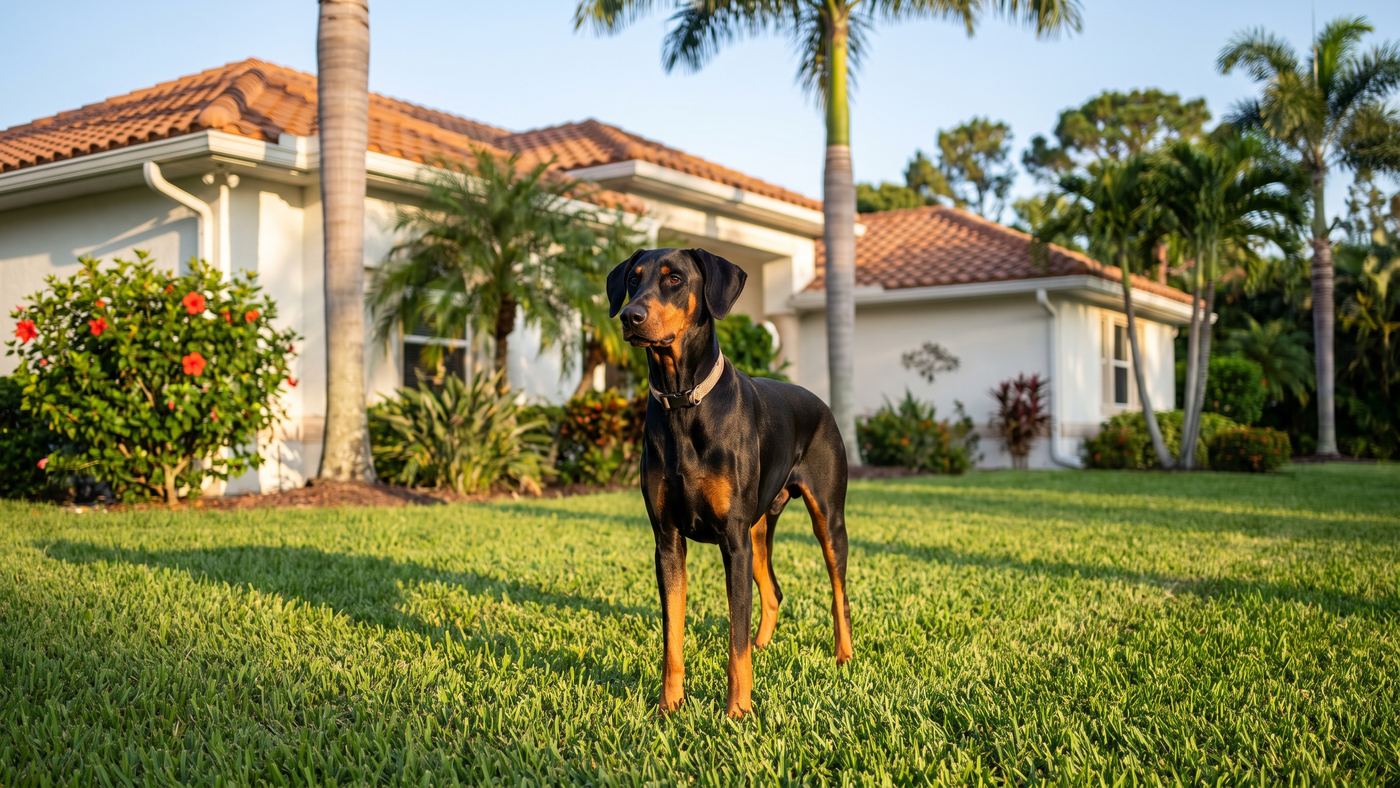
1. Doberman Pinscher. The strongest match in the group. A short single coat, a long muzzle that moves real air, and a working weight of 60 to 100 pounds, under the 50 kg line where the RVC data turns. Dobermans are territorial and alert without needing to be heavy, which is precisely the trade Florida rewards. Whatever list you were reading before, in this climate the Doberman is number one.
2. Belgian Malinois. Short coat, long muzzle, light frame. On paper the best-cooled dog here. The catch is drive: a Malinois will work itself into trouble in the heat because it does not choose to stop, so the handler has to stop it. This is not a first dog, and it is not a dog for a household that leaves it alone all day.
3. Rhodesian Ridgeback. Bred as a hunting and guarding dog in southern Africa, with a coat so short it is barely there. Reserved with strangers, quiet, and physically built for a hot climate rather than adapted to one. At 70 to 85 pounds it sits comfortably under the weight threshold.
4. German Shepherd Dog. The default guard dog in America, and a genuinely capable one, but the double coat is the compromise. It insulates in both directions, which helps more than owners expect: do not shave a German Shepherd, because the undercoat is part of the cooling system, and shaving removes the sun barrier without improving airflow. Plan the schedule around the coat instead: early and late, shade, water.
5. Anatolian Shepherd. Bred for the heat of the Anatolian plateau and utterly serious about guarding, but this is a livestock guardian, not a personal protection dog. It wants territory and a job, not a townhouse. At 80 to 150 pounds many individuals sit above the 50 kg line, which puts them in the RVC risk band regardless of ancestry.
6. Rottweiler. Powerful, confident, famously handler-focused. Two things work against it here: a mostly black coat that absorbs sun, and a build that runs to 135 pounds. A Rottweiler does fine in Florida with a disciplined schedule and shade; it does badly with a midday walk in an open subdivision.
7. Giant Schnauzer. An outstanding guarding temperament in a dense, wiry double coat that was designed for northern European weather. Owners here spend real money and time on grooming, and even a well-kept coat is warmer than a Doberman's. Workable, with effort.
8. Cane Corso. Short coat, which helps, but the shortened muzzle and 90 to 110 pounds of dog work against it. This is the breed where owners most often misread the risk, because the coat looks like a hot-weather coat. Airflow matters more than hair.
9. Akita. A thick double coat bred for the mountains of northern Japan. Akitas live in Florida and can be perfectly happy indoors, but the outdoor half of guarding is genuinely limited here, and summer exercise windows are short.
10. Bullmastiff. The breed carries both RVC risk factors at once: a brachycephalic head and 100 to 130 pounds of bodyweight. It was bred to hold an intruder rather than to patrol, which suits it, because patrolling a Florida yard in July is not something to ask of this dog.
What Florida changed in 2023, and what it did not
For years the answer to "can I own that breed here" depended on where you lived. That ended on October 1, 2023, when the change made by House Bill 941 took effect. Section 767.14, Florida Statutes, now lets local governments write their own dog ordinances "provided that no such regulation is specific to breed, weight, or size," and the bill removed the grandfather clause that had protected pre-1990 local breed bans. That is what ended Miami-Dade County's pit bull ban, in force since 1989. The bill also stopped public housing authorities from banning dogs by breed, weight or size.
Here is the part that catches people out. That law binds governments. It does not bind your HOA, your condo board or your insurer.
Private associations in Palm Beach County still write breed restrictions into their CC&Rs, and they are still enforceable: we covered the typical banned list and where federal housing law overrides it in a separate piece on HOA breed restrictions. Homeowners insurers likewise still exclude or surcharge specific breeds in Florida; several states have banned that practice, and Florida is not among them. Before you commit to a Rottweiler or a Cane Corso, read your association documents and call your carrier. It is a fifteen-minute job that has saved people from a very expensive surprise.
The two rules of Florida dog law every guard dog owner should know
Florida has no "one bite" rule. Under section 767.04, the owner of a dog that bites someone in a public place, or lawfully in a private place including the owner's own property, is liable for the damages "regardless of the former viciousness of the dog or the owners' knowledge of such viciousness." There is no free first bite in this state. A guard dog's whole job description makes this the statute to understand.
The "Bad Dog" sign is a real defense, with real holes. The same statute says an owner is not liable if a sign easily readable and including the words "Bad Dog" was displayed in a prominent place on the premises, except as to a person under the age of six, and unless the damages were proximately caused by the owner's own negligent act or omission. So the sign does nothing where a child is involved, and nothing where a gate was left open. It is a defense, not armor.
Beyond that sits section 767.12, which sets out what happens after a serious incident: a dog classified as dangerous must be registered annually, microchipped, sterilized, kept in a proper enclosure with warning signs posted at entry points, and muzzled and restrained by a substantial chain or leash under the control of a competent person any time it leaves that enclosure. The owner must carry liability coverage of at least $100,000. Violations are noncriminal infractions carrying fines of up to $1,000 each.
What is actually the best guard dog for Florida heat?
The Doberman Pinscher. Short single coat, long muzzle, and a working weight under the 50 kg mark where the RVC data shows heat risk climbing. It gets the guarding temperament without the mass.
Can my Florida city ban my breed?
No. Since October 1, 2023, section 767.14 has barred local dog regulations "specific to breed, weight, or size," and the change removed the exemption that had protected older bans such as Miami-Dade's. Your HOA and your insurer are a separate matter and are not covered by that law.
Does a "Bad Dog" sign protect me if my dog bites someone?
Partly. Section 767.04 makes it a defense, but it does not apply if the person bitten was under six years old, or if the owner's own negligence proximately caused the injury.
Is a big guard dog safe to leave in a Florida yard all day?
No breed on this list should be spending a summer day outdoors here. The RVC study found nearly three quarters of heat-related illness cases followed activity, mostly walking, and a large dog patrolling a fence line in July is doing exactly that.
Guarding is a temperament, not a workload
One thing worth saying plainly: for most households the security value of these breeds is deterrence and alerting, not bite work. A dog that notices and announces is doing the job. Bite work is a specialised training discipline with its own liability profile, and it is a separate decision from choosing a breed.
What every dog on this list does share is a need for real daily exercise and a person who is consistent with it, which in Florida means someone available at the right hours, not at whatever hour is convenient. That is where these breeds most often go wrong: not badly bred, just under-walked in the only two windows the climate allows.
Our sitters work with large, protective breeds every week, and the first thing they do is spend time with the dog on its own ground before anything is booked. That is what the free meet & greet is for: twenty minutes at your door, no card on file, so your dog meets the person face to face and you watch how they handle each other. For a guarding breed, that introduction is not a formality: it is the whole basis of whether the arrangement will work.
This article is general information about Florida law, not legal advice. For your own situation, talk to a Florida attorney.

Discussion
Questions get answered here. Reading is open to everyone.
Every comment is read by an automatic check before it appears. Phone numbers, emails and offers of pet care go to a moderator instead of the page.
Sign in to join the discussion. Reading is open to everyone; posting, replying and voting need an account, which keeps the comments answerable to a real person. Sign in or create an account
- Nobody has said anything yet. If the article left a question open, ask it here and we will answer.