
Florida's most popular cats, and what doctors say
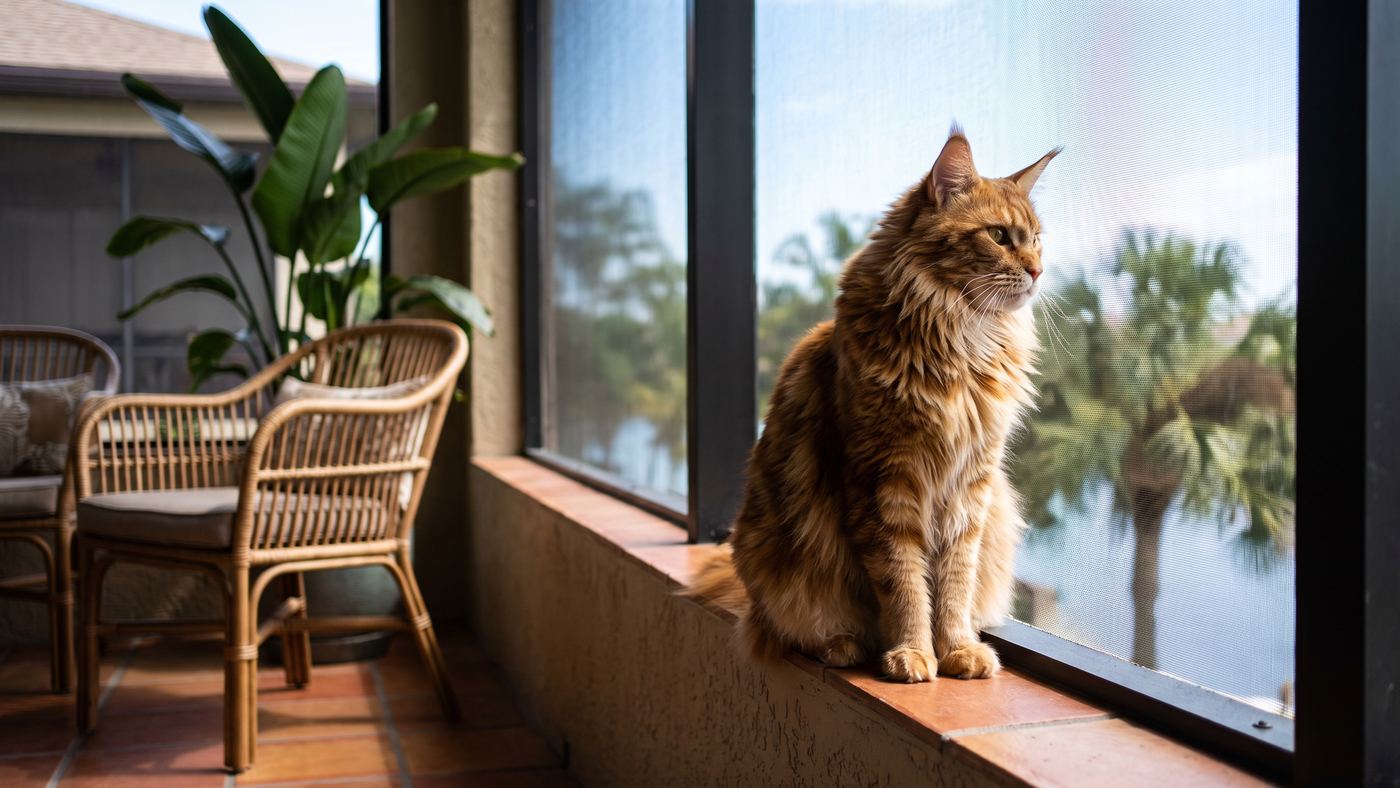
There are two answers to "what cats are popular in Florida," and they describe different animals.
One is the pedigree list, which tracks what people register with a breeder association. The other is the cat actually sitting on a lanai ledge in Boynton Beach right now, which is almost certainly a domestic shorthair from a shelter, because the great majority of American cats are random-bred and always have been. Both lists are worth knowing, for different reasons.
The pedigree list: CFA's top ten for 2026
The Cat Fanciers' Association publishes its ranking every March, based on the previous year's registration data. For 2026 the top ten runs:
- Maine Coon
- Ragdoll
- Persian
- Exotic
- Devon Rex
- Abyssinian
- British Shorthair
- Siberian
- American Shorthair
- Russian Blue
The Maine Coon took first place for the second year running. The Devon Rex has been the most popular shorthaired breed for five straight years. The American Shorthair is the notable return, back on the list after dropping off.
For context on scale: the AVMA's national survey puts roughly a quarter of US households in the cat-owning column, and state-level compilations of that data place Florida at about the same share, but only 36th among the states. Florida is a dog state that happens to contain a lot of cats.
Which of those ten actually suit a Florida house
The ranking is national. The filter here is local, and it comes down to coat and face.
The long coats: Maine Coon, Siberian, Ragdoll, Persian. These do fine in Florida, with an asterisk: they do fine indoors, in air conditioning that runs nine months a year. Do not shave a long-coated cat for the summer. The coat is insulation in both directions and a sun barrier, and cats regulate heat mainly through grooming and by choosing cool surfaces, not through the coat. What they need instead is more brushing than a northern owner would expect, because humidity and shedding season here are effectively year-round, and a matted undercoat traps heat against skin.
The flat faces: Persian and Exotic. Both are brachycephalic, and the same shortened skull that shapes the face restricts the airway. In a climate where a power outage means an un-airconditioned house within an hour, that is a real consideration and not a cosmetic one. If you keep a Persian or an Exotic in South Florida, your hurricane plan needs to include where the cat goes when the AC stops.
The Devon Rex. A very thin, sparse coat, which sounds ideal for the tropics and is not. Thin-coated and light-coloured cats sunburn, and the classic spot is the ears and nose of a cat that spends every afternoon in a bright Florida window. Ask your vet about it before assuming a sunny window is a free enrichment.
The easiest fits. Abyssinian, British Shorthair, American Shorthair and Russian Blue: short-coated, normal-muzzled, unremarkable in the best sense. The same is true of the shelter domestic shorthair, which is why it remains the sensible default for a Florida household.
What the doctors actually say
This is where the internet stops being useful, because "cats are good for your heart" gets repeated without anyone reading the source.
The strongest cardiac claim comes from a University of Minnesota analysis presented at the American Stroke Association's conference in 2008. Researchers followed 4,435 adults from the second National Health and Nutrition Examination Survey and found that people who had never owned a cat had roughly a 30% higher risk of death from cardiovascular disease and about a 40% higher risk of death from heart attack than current or former cat owners. Past cat ownership was associated with a 37% lower risk of fatal myocardial infarction after adjusting for age, sex, race, blood pressure, smoking, diabetes, cholesterol and BMI.
That is a real finding from a real cohort. It is also observational, which means it can show an association and cannot show a cause.
The formal position is more careful, and worth quoting properly. The American Heart Association issued a scientific statement on pet ownership and cardiovascular risk in 2013. Its two recommendations were: pet ownership, particularly dog ownership, may be reasonable for reduction in cardiovascular risk (Class IIb, Level of Evidence B); and pet adoption, rescue or purchase should not be done for the primary purpose of reducing cardiovascular risk (Class III, Level of Evidence C).
Read those together and the message is clear. Cardiologists think there is probably something there. They explicitly do not think you should acquire an animal as a treatment.
What the psychologists say, including the part cat people skip
Here the honest answer is less flattering, and you deserve it rather than the marketing version.
A systematic review and meta-analysis published in Annals of General Psychiatry in 2025 pooled 21 studies covering more than 159,000 participants. Overall, pet ownership showed no significant association with depression, an odds ratio of 1.03, confidence interval crossing 1. Dog ownership came out at 0.93, also not significant. Cat ownership came out at 1.06 with a confidence interval of 1.02 to 1.09: a small but statistically significant association with higher reported depression.
Before anyone rehomes a cat over that sentence, understand what it almost certainly reflects. Every study in the pool was observational. The most plausible reading is reverse direction: people who are isolated, housebound, grieving or already struggling are more likely to acquire a cat, precisely because a cat is the companion that fits a life with limited mobility or energy. The authors list the limitations themselves: cross-sectional designs, self-reported measures, and no longitudinal evidence establishing causality.
So the fair summary is this. A cat is not a medical intervention, and no responsible clinician will prescribe you one. What the research does support, consistently, is narrower and more human: a routine, a reason to come home, a warm animal in a quiet house. That is not nothing. It is just not a prescription, and the studies that pretend otherwise are the ones to distrust.
None of the above is medical advice.
The Florida health fact that is not ambiguous at all
While the psychology is murky, one thing about cats in this state is completely settled, and most owners get it wrong.
Heartworm. The American Heartworm Society is blunt: there is no approved drug therapy for heartworm infection in cats, and the drug used to treat dogs is not safe for cats. Treatment consists of stabilising the animal, not clearing the parasite. Cats usually carry six worms or fewer, sometimes only one or two, and one or two worms can make a cat very ill. Even immature worms cause damage, through a condition called heartworm-associated respiratory disease, which is routinely mistaken for feline asthma.
"My cat lives indoors" is not protection. Mosquitoes come inside, and in a North Carolina study of cats diagnosed with heartworm, roughly one in four were described by their owners as indoor-only. Florida is one of the highest-risk states in the country, and our mosquito season is the calendar. The AHS guidance is Think 12: test annually, and give preventive twelve months a year, starting kittens as early as the product label allows and no later than eight weeks of age.
If you take one action item from this article, make it that one. It costs a conversation with your vet and it is the single largest preventable risk your Florida cat faces.
What is the most popular cat breed right now?
The Maine Coon, which took the Cat Fanciers' Association's top spot for 2026, its second year in a row. The CFA ranks pedigreed registrations from the prior year, so it describes the breeder market rather than the cats in Florida shelters.
Do cats really lower your risk of heart disease?
An observational study of 4,435 adults found never-owners had about 30 to 40 percent higher cardiovascular death risk than cat owners. But the American Heart Association's formal position is that a pet "should not be adopted... for the primary purpose of reducing CVD risk."
Should I shave my long-haired cat for the Florida summer?
No. The coat insulates against heat as well as cold and shields against sun. Brush more instead: matted undercoat is what actually traps heat against the skin.
Does an indoor cat in Florida need heartworm prevention?
Yes. There is no approved treatment for heartworm in cats, mosquitoes get indoors, and about one in four cats diagnosed with heartworm in one study were reported as indoor-only. The American Heartworm Society recommends prevention twelve months a year.
Living with a cat in a house, not a condo
Most of the cat advice online is written for apartments. A Florida house changes the questions.
The lanai is the compromise that works. A screened porch gives a cat outdoor air, birds to watch and sun to lie in, without the traffic, the hawks or the neighbourhood tom. Check the screen where it meets the frame: a determined cat finds the loose corner, and remember that a lanai is not shade. Tile that is comfortable at nine in the morning is hot by two, and a cat that has been shut out there while you are at work has no way back to the cool floor.
Water in more than one place. Cats drink poorly by nature, and in a house with a big footprint, a bowl at the far end of a hallway may as well not exist. Several bowls, refilled daily, beat one perfect fountain.
The AC is life support, not comfort. When the power goes out in September, the coolest place in a Florida house is an interior tiled bathroom floor, and that is where the cat should be able to get to. Anyone checking on your house during an outage needs to know that.
When you leave, the cat should not
The one thing that is genuinely different about cats: they bond to territory more than to travel. Moving a cat to a boarding facility for a week means a new smell, a new noise floor and a stranger's schedule, and most cats spend the week hiding rather than settling. Cats generally do better staying home with someone coming to them: same room, same litter box, same window ledge, someone in the house daily to feed, scoop, refill water and confirm the AC is still running.
That is the whole argument for drop-in visits over boarding for a cat, and it is why we treat cat care as its own service rather than a smaller version of dog care.
Every new client here starts with a free meet & greet: twenty minutes at your door, no card on file. For a cat that means the sitter meets the animal on its own ground, learns where it hides, which door must never be opened and where the food actually lives, before anything is ever booked. Some cats stroll straight out to say hello. Some watch from under the bed the whole time. Both are useful information, and it is much better to learn it now than on day one of your trip.


Discussion
Questions get answered here. Reading is open to everyone.
Every comment is read by an automatic check before it appears. Phone numbers, emails and offers of pet care go to a moderator instead of the page.
Sign in to join the discussion. Reading is open to everyone; posting, replying and voting need an account, which keeps the comments answerable to a real person. Sign in or create an account
- Nobody has said anything yet. If the article left a question open, ask it here and we will answer.