
Cruises and pets: what Florida ports really allow
· 46 views
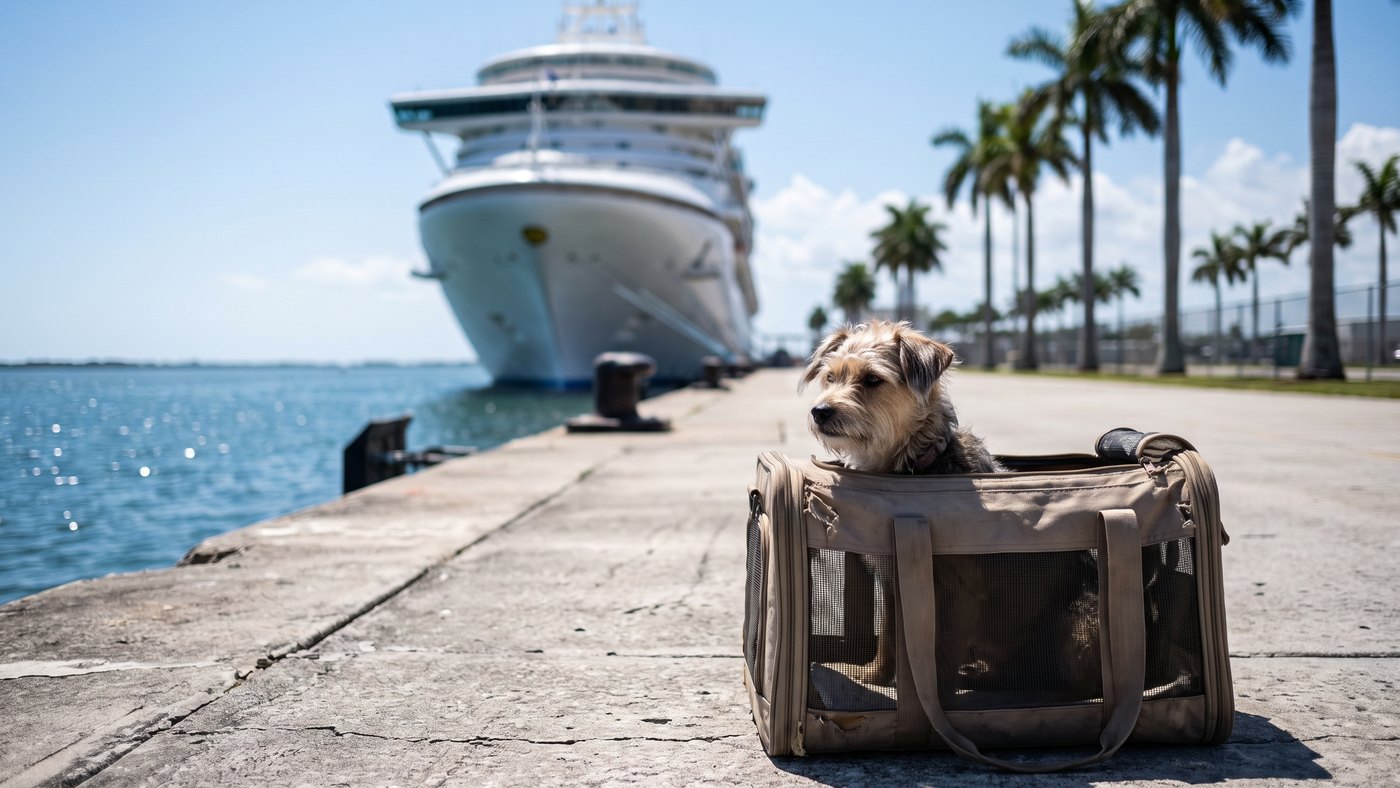
A reader wrote to us this week with a story that is more common than it should be. He had booked a cruise, flown in, and arrived at the terminal with a small dog in a carrier. He was not allowed to board. The dog was not the problem in the sense he expected. The problem was that no cruise line sailing out of Florida takes pets at all, and nobody had told him, because nobody sells you a ticket by explaining what you cannot bring.
We went through the published policies of the lines that sail from Port Everglades, PortMiami and Port Canaveral. Here is what we found, why the confusion happens so reliably, and what you can actually do if you are standing at a terminal right now with a dog and a boarding pass.
The short answer
No cruise line departing from a Florida port accepts pets. Not small ones. Not in a carrier. Not in the cabin. Not in the hold. Not for a fee.
There is no premium tier that unlocks it, no note your veterinarian can write, and no size below which the rule stops applying. A four pound dog and a hundred pound dog are refused on exactly the same grounds.
This is not squeamishness about animals. A cruise ship is a floating food service operation that clears customs and agriculture inspection in a different country every morning. Carrying an animal means an import clearance in every port of call, quarantine exposure for the vessel, and facilities that ships built for people do not have.
The one exception, and it does not sail from here
There is exactly one commercial passenger ship in the world that carries pets: Cunard's Queen Mary 2, which maintains 24 kennels for transatlantic crossings between New York, Southampton and Hamburg.
Every detail of it argues against treating it as an option for a Florida holiday. The kennels exist only on the transatlantic route, not on Caribbean sailings. The animals live in the kennel area for the whole voyage and may not visit cabins or public rooms. Capacity is 24 per crossing and it books out far ahead. Queen Mary 2 does call at Port Everglades on some itineraries, and that is precisely the trap: calling here is not the same as carrying your dog from here.
So the honest framing is that the exception exists, it is real, and it is a way to move a dog across the Atlantic rather than a way to take a dog on holiday.
Where the confusion actually comes from
Almost every one of these stories has the same root, and it is worth being precise about it, because the precision is the part that saves the trip.
Service dogs are permitted. Emotional support animals are not. Those are two different legal categories, and cruise lines treat them as two different categories.
A service dog under the Americans with Disabilities Act is a dog individually trained to perform specific tasks for a person with a disability: guiding someone who is blind, alerting someone who is deaf, retrieving, interrupting a seizure, fetching medication. The definition rests on trained work.
An emotional support animal provides comfort by its presence. That is a genuine benefit and it is not a trained task, and under the ADA it is not a service animal.
Every major line states this in some form. Norwegian is explicit that emotional support dogs are not accepted as service dogs and cannot sail. Carnival permits working service dogs and states that pets, and service dogs in training, are not allowed aboard. Royal Caribbean and Celebrity welcome trained service dogs across their fleets on the same basis.
Airlines changed their rules on emotional support animals a few years ago and a great many owners learned the new landscape at an airport gate. Cruise terminals are where the same lesson is now being taught.
There is also a smaller trap inside the larger one. Websites that sell registrations, certificates and vests for a fee do not create a legal status. No registry confers service animal status in the United States, and a terminal agent is not evaluating your paperwork so much as your dog's trained function.
The second trap: the ports, not the ship
Suppose you genuinely have a trained service dog and the line has accepted it. You are not finished, because the ship is not the only authority involved.
Every country where the animal steps off the ship applies its own import rules, and those rules generally do not carve out an exception for assistance animals.
The Bahamas is the case that matters most here, because a large share of short cruises from Florida call there. Bahamian requirements include an import permit from the Ministry of Agriculture and Fisheries, a microchip, current rabies vaccination, and a veterinary health certificate examined within two days of arrival. The rules apply to dogs and cats including assistance and service animals, the animal must be at least six months old, and the guidance is to apply about four weeks ahead.
Four weeks. That is the number that turns a spontaneous booking into an impossible one, and it is the number nobody encounters until they go looking for it.
The three Florida ports
Port Everglades, Fort Lauderdale. A homeport for a range of lines and a port of call for many more, including Costa, Cunard, Oceania and Regent Seven Seas.
PortMiami. Home to more cruise company headquarters than anywhere in the world, including Carnival, Royal Caribbean, MSC, Norwegian and Celebrity.
Port Canaveral. Homeport for seven lines: Royal Caribbean, Carnival, Disney, MSC, Princess, Celebrity and Norwegian.
The list matters less than the pattern. Across all three ports and every line on it, the pet policy is the same policy. Choosing a different terminal does not change the answer.
What actually happens at the terminal
Boarding is refused at check-in, before security, by an agent who has no authority to make an exception and no facility to hold an animal.
What follows is a matter between you and your ticket contract, and those contracts generally place the responsibility for meeting boarding requirements on the passenger. Read yours before you assume anything about a refund, and if you booked through an agent or on a card with travel protection, call them the same day rather than the following week.
The ship does not wait. That is the part that turns an administrative problem into a crisis in about ninety minutes.
If you are at the port right now
Practical, in order.
Ask the terminal, not the internet. Some terminals can point to nearby boarding facilities they have dealt with before. It costs one question.
Call boarding kennels within reach of the port, and say the word emergency. Vacancies exist that are not visible on a website, and a facility that shows full for a week can often take an animal that arrives in the next hour if someone is willing to say yes on the phone.
Have the vaccination record on your phone. No reputable boarding facility takes a dog without proof of rabies, and usually distemper and bordetella. A dog whose records are at home in a drawer is a dog nobody can accept, and this is the single most common reason an emergency placement fails.
Do not leave an animal in a car. A vehicle in a Florida parking garage in summer is lethal within minutes. This needs saying because people in a panic do it.
Decide fast whether the trip is salvageable. If the answer is no, the calm version of losing the cruise is much cheaper than the frantic version.
If you are anywhere in our corridor, from Boca Raton down to Deerfield and Pompano or up to West Palm Beach, call us and we will tell you honestly within a few minutes whether we can cover it. Sometimes we can take an animal the same day. Sometimes we cannot, and then the useful thing we can do is tell you that immediately instead of leaving you hoping.
How to plan it so this never happens
Read the line's own accessibility page before you book, not a travel blog and not a forum thread. The policies are published and they are short.
If your dog is a trained service animal, start the paperwork about six weeks out. Notify the line, then work through the import requirements for every port on the itinerary, one country at a time.
If your dog is an emotional support animal, plan for the dog to stay home. This is the hard sentence in this article, and pretending otherwise is how people end up at a terminal.
Book the dog's care when you book the cabin. Boarding facilities and sitters fill up around exactly the dates that cruises depart, because everyone is leaving at once.
Keep vaccination records where you can reach them from your phone. This costs five minutes once and it is the thing that saves you.
A cruise is one of the few holidays where the answer for a dog is genuinely settled before you start. Knowing that early is not bad news. It is the difference between arranging something good for the animal in advance and improvising at a terminal with the clock running.


Discussion
Questions get answered here. Reading is open to everyone.
Every comment is read by an automatic check before it appears. Phone numbers, emails and offers of pet care go to a moderator instead of the page.
Sign in to join the discussion. Reading is open to everyone; posting, replying and voting need an account, which keeps the comments answerable to a real person. Sign in or create an account
- Nobody has said anything yet. If the article left a question open, ask it here and we will answer.