
Dogs on Florida trains: Brightline, Tri-Rail and Amtrak
· 40 views
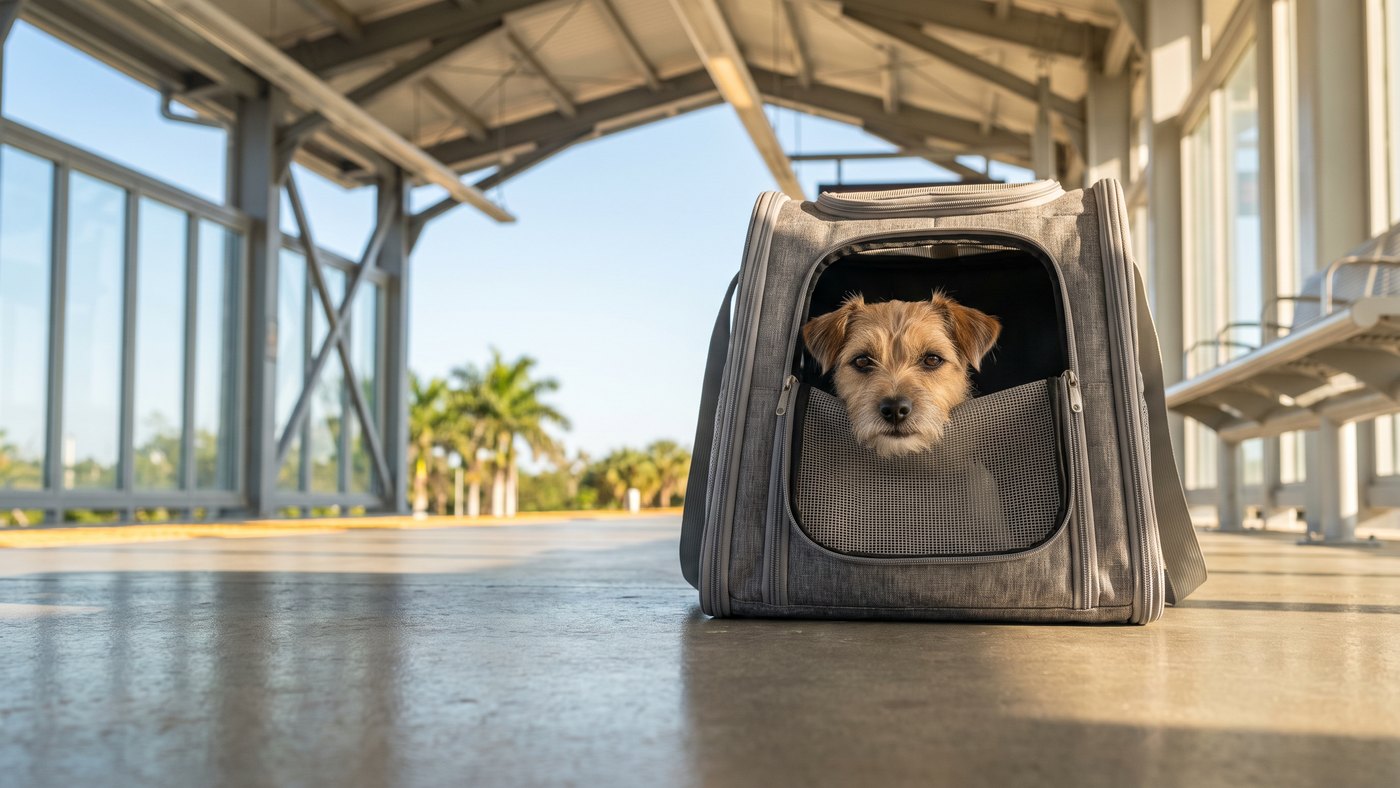
Three different railroads run through Palm Beach and Broward, and each one has its own rulebook for dogs. They do not agree with each other. A dog that boards Brightline in Boca Raton at nine in the morning may be turned away from a different platform in the afternoon, and nothing about that is arbitrary once you know what each operator actually wrote down.
This is the practical version: what each line permits in its own words, where the stations are, and how to keep a dog safe on a train that reaches 125 miles an hour between West Palm Beach and Cocoa.
Brightline, in Brightline's words
Start with the rule most people get wrong. There is no published weight limit. Search results will tell you twenty pounds, or twenty five. Brightline's own terms of service set a container size instead, and the animal has to fit in it.
The terms state that "dogs and cats are the only pets that are permitted to travel on our trains." Carry-on pets travel "inside a closed, approved hard or soft sided, leak proof pet carrier," and that carrier "may not exceed 17" x 10" x 10"" when it rides under the seat or on your lap.
The rest of the policy, condensed but not paraphrased away:
One per adult. "Adults (13+) may bring one (1) pet per passenger."
Tell them before you board. The pet goes on the reservation at least ten minutes before departure. Turn up unannounced and the company reserves the right to refuse the animal.
Eight weeks minimum. Carry-on pets "must be at least eight weeks old."
A behavior standard, written as one. Pets must be "odorless, harmless, not disruptive and require no attention during travel." That is not decorative language. It is the clause a crew member points at when a dog barks through Fort Lauderdale.
The carrier stays shut past security. In lobbies and outside the station a leash is enough. Past the security point, including the lounges and the train itself, the animal stays inside the carrier.
The carrier counts as your bag. You may bring the carrier plus one personal item. It replaces the carry-on you would otherwise have brought, which is the detail that ruins the packing plan of everyone who learns it at the station.
Pets do not travel as checked baggage. The animal travels with you or not at all.
Service animals are a separate category, accepted at no charge, permitted at your feet or on your lap, and kept leashed, harnessed or tethered unless those devices interfere with the animal's work.
The stations, and where they actually are
- West Palm Beach. 501 Evernia Street, West Palm Beach. Pet relief area outside.
- Boca Raton. 101 NW 4th Street, Boca Raton. This is the one most of our clients use.
- Fort Lauderdale. 101 NW 2nd Avenue, Fort Lauderdale. Pet relief area outside.
- Aventura. 19796 West Dixie Highway, at Aventura Mall.
- MiamiCentral. 600 NW 1st Avenue, Miami.
- Orlando. Orlando International Airport, at Terminal C, joined to the terminal by a covered walkway.
The two relief areas are worth planning around. Boca Raton, Aventura and MiamiCentral do not advertise one, so the last chance to let a dog empty out is before you park.
Tri-Rail is not Brightline
Different operator, different rulebook, and people conflate them constantly because the tracks run near each other.
The South Florida Regional Transportation Authority tariff policy is blunt: with the exception of service animals, large animals are prohibited on board. Small pets are permitted only when enclosed in a proper carrying cage.
There is no size table and no reservation step. There is also no room for interpretation about a fifty pound dog on a leash. If the animal is not in a cage, it is not riding, and that decision belongs to the conductor standing in front of you.
Amtrak is a third set of rules
Amtrak runs the long distance trains through Florida, and its pet page is the most detailed of the three.
The headline requirements: dogs and cats only, always in a carrier, a "20-pound limit (combined weight of pet and carrier)," and travel "only on trips up to 7 hours on most routes."
Three details on that page contradict what most travel articles repeat, so read them from the source rather than from a summary.
The carrier goes under your own seat. Amtrak's wording is specific: place the carrier "under your seat (not under the seat in front of you)." Almost every secondhand guide says the opposite.
There is no flat fee to quote. Amtrak states that pet fees "vary by route and will be shown in the price summary at time of reservation." Articles quoting a single dollar figure are quoting a number the railroad no longer publishes.
Class matters. Pets ride in Coach and Acela Business Class. They may not travel in Acela First Class, non-Acela Business Class, First Class private rooms or food service cars, and they are not allowed in any station lounge or First Class waiting area.
The animal stays entirely inside a closed carrier in stations and on board, and must remain with you at all times. Amtrak does not ship pets or accept them as checked baggage: "a pet must travel with a human." Service animals are not counted as pets and are welcome on all Amtrak services.
What 125 miles an hour actually does to a carrier
Here is the part no policy document covers.
Brightline's top speed on the stretch north of West Palm Beach is 125 miles an hour. At that speed the ride is smooth, and smooth is exactly what lulls people into placing a carrier badly.
The carrier goes on the floor, wedged. Between your feet, or between your feet and the seat frame, so it cannot slide. Not on the seat beside you, where a hard brake throws it into the aisle. Not on the overhead shelf, ever, no matter how light the dog is.
Face the direction of travel if you can choose. In a sudden deceleration a passenger facing forward is pressed into the seat back ahead. A passenger facing backward is thrown forward against the belt of their own body weight, and so is anything on their lap.
Keep a hand on it during braking and departure. Station approaches and departures are where the accelerations live. Cruising at speed is the calmest part of the trip.
Do not open the carrier to comfort the dog. This is the single most common mistake. A frightened dog in an unfamiliar metal tube with strangers and pressure changes is a dog looking for an exit. Talk to it through the mesh, put a finger in, leave the door shut.
The platform is more dangerous than the train
Almost every genuinely bad outcome involving a dog at a railway station happens on the platform, not in the car.
The gap. A small dog's leg fits into the space between platform and car. Carry the carrier across the threshold rather than setting it down and sliding it.
The doors. They close on a schedule, not on your dog. A leash trailing behind an animal that is halfway through is the classic incident, which is why the carrier rule past security exists at all.
The edge. Florida platforms are open and hot and there is no barrier on most of them. A dog that pulls, at any weight, is a dog that can pull you both toward the edge. A leash goes on your wrist through the loop, not held loosely in fingers.
The heat. This is our variable, not theirs. A concrete platform in July is a griddle, and paw pads burn before a human notices anything wrong through shoes. The back of your hand on the concrete for seven seconds is the test. If you cannot hold it there, the dog should not be standing on it. Carry the animal across, wait in the shade or the lobby, and remember the carrier itself is a warm box with limited airflow.
If something goes wrong
Trains stop hard occasionally. Grade crossing incidents happen on this corridor, and a train that brakes from speed does so without warning to passengers.
Stay seated and keep the carrier down. The instinct to stand up and check on the animal is the instinct that gets people hurt. The floor is the safest place for the carrier and your seat is the safest place for you.
Follow the crew, not the crowd. In any evacuation the animal stays in the carrier and the carrier comes with you. It is hand luggage now. Do not clip a leash on and walk a loose dog through an evacuating train.
If you must open it, clip first. Leash to collar before the door opens, every time, with the carrier held between your knees. A dog that gets loose in a rail corridor is a dog next to live track.
Know what you are carrying. A photo of the dog on your phone, the microchip number in your notes, and a tag with a phone number that someone will actually answer. If you are separated at MiamiCentral, that is what turns a catastrophe into an inconvenience.
Before you leave the house
A short list that prevents most of the trouble:
Walk the dog properly before you drive to the station, not after you arrive. Skip the meal within about three hours of departure. Put an absorbent pad in the carrier even for a confident traveler. Bring water and a collapsible bowl and offer it in the lobby rather than on board. Practice the carrier at home for a week before the trip, with the door open and something good inside, so the box is not introduced on the day it matters.
And take the animal's side of the decision seriously. A dog that panics in a car is not going to enjoy a train, and a two hour trip to Miami is not worth doing to a frightened animal to save a drive.
When the answer is not to take the dog
Sometimes the honest answer is that this trip is not a dog trip. A day in Orlando, a work meeting in Miami, a flight out of MCO with the train as the connection. In those cases the dog is better off at home with someone coming through the door.
That is most of what we do. If the train is the right call for you and the wrong call for the dog, tell us the dates and we will cover the house while you are gone. We are on the same corridor: Boca Raton, Delray, Boynton, Deerfield, Pompano, West Palm Beach and Wellington.


Discussion
Questions get answered here. Reading is open to everyone.
Every comment is read by an automatic check before it appears. Phone numbers, emails and offers of pet care go to a moderator instead of the page.
Sign in to join the discussion. Reading is open to everyone; posting, replying and voting need an account, which keeps the comments answerable to a real person. Sign in or create an account
- Nobody has said anything yet. If the article left a question open, ask it here and we will answer.