
Alligators and dog walks in South Florida: the real rules
· 67 views
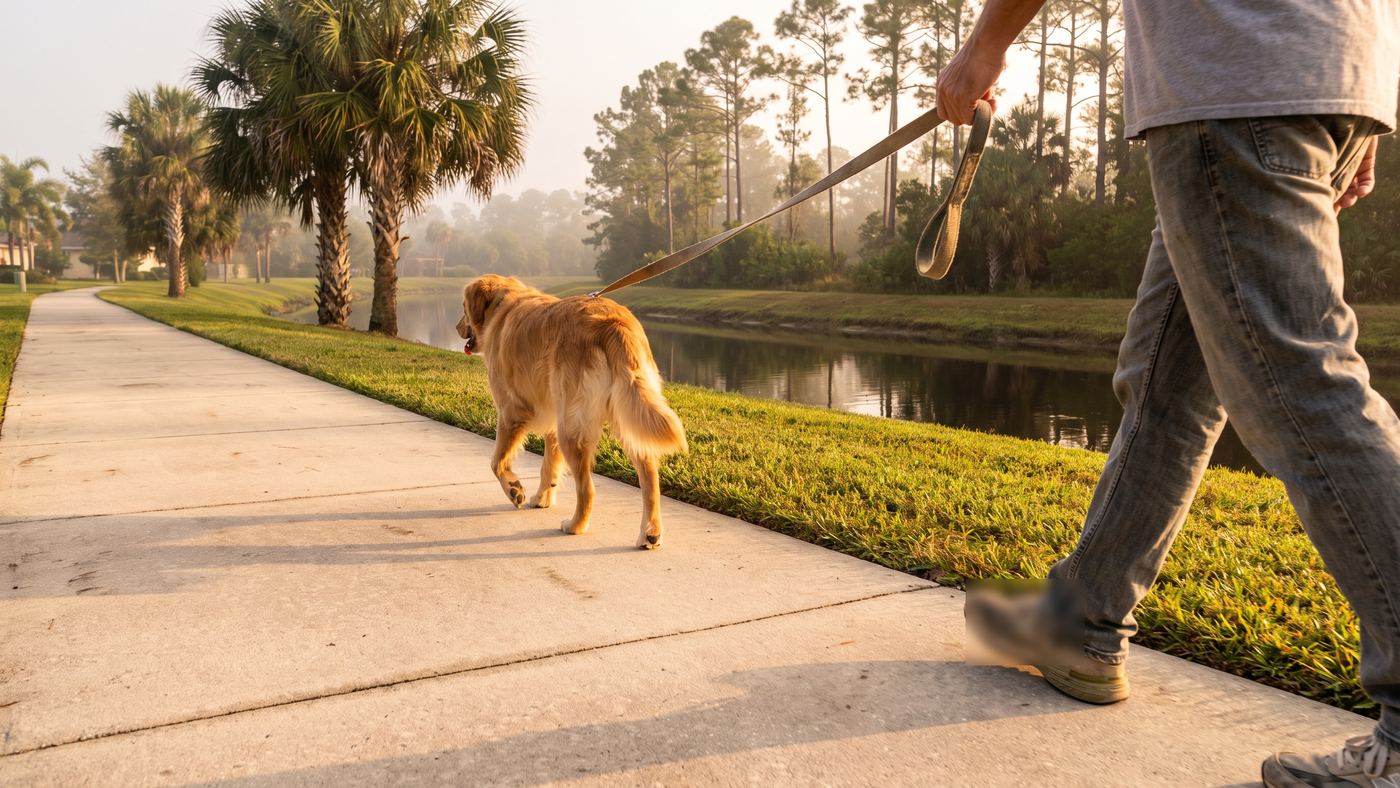
Every Florida dog owner learns two rules in their first summer. Walk early and walk late, because midday pavement burns paws. And stay away from the water at dusk and dawn, because that is when alligators are moving. Both are correct. Together they describe a very narrow window, and nobody ever explains how to hold both at once.
Here is the version that works, built from what the Florida Fish and Wildlife Conservation Commission actually publishes rather than from neighborhood folklore.
Start with the real numbers
FWC estimates Florida holds about 1.3 million alligators of every size, spread across all 67 counties, living in practically every fresh and brackish water body in the state and occasionally in salt water. That estimate rests on roughly 6.7 million acres of suitable habitat.
Against that, the risk to people is small and well documented. Over the last ten years Florida has averaged eight unprovoked bites a year serious enough to need professional medical treatment. From 1948 through 2022 the state recorded 453 unprovoked bite incidents, 26 of them fatal. FWC puts the likelihood of a Florida resident being seriously injured in an unprovoked alligator incident at roughly one in 3.1 million.
Now the part that changes the math for anyone holding a leash. FWC states it plainly: dogs are more susceptible to being bitten than humans, because dogs resemble the natural prey of alligators. The agency adds a detail most owners have never heard: the sound of dogs barking and playing may draw an alligator to the area. Your dog is not covered by the human statistic above. To an alligator, your dog is a different animal entirely.
The water is closer than you think
In Boca Raton, Delray Beach and Boynton Beach the freshwater system runs straight through the neighborhoods. The El Rio Canal, the Boca Raton Canal and the Hillsboro Canal tie the coastal grid to the drainage system out west, and nearly every subdivision built since the 1970s has a lake behind it. Those lakes are the drainage, not decoration. Golf course ponds are the same water.
Working rule: treat every pond, canal and lake in Palm Beach and Broward as occupied, whether or not you have ever seen anything in it. FWC notes that bites on humans have occurred in a wide variety of water bodies, many of them small and not regularly used by alligators.
Distance is the whole game
An alligator is built for ambush from water, not for a chase across a lawn. FWC's own wording: although alligators can move quickly on land, they are not well adapted for capturing prey out of the water, but they can lunge at prey within a few feet of the shoreline.
That one sentence gives you the rule. The danger is a narrow band along the bank, and staying out of it is a matter of walking habits:
- Keep the dog leashed and off the water's edge. Not "near you": off the edge. A retractable leash paid out to twenty feet puts your dog inside the strike band while you stand safely on the path.
- Never let a dog swim, wade, exercise or drink in or near fresh or brackish water. Drinking counts: that is a dog with its head down at the waterline.
- Where a path runs along a canal, walk the sidewalk side, not the bank side.
- Do not throw a ball anywhere a bad bounce ends in the water.
The hours, and how to reconcile them with the heat
FWC's guidance is that alligators are most active between dusk and dawn. Florida heat guidance points at the same hours for the opposite reason. The two are compatible, because they are about different places: the heat rule is about pavement and sun, the alligator rule is about water.
So take the early and the late walk, and take them on sidewalks and open turf away from water. Save any waterside route for the middle of the day, when you would be sticking to shade anyway, and keep it short.
The season has a shape
Alligator behavior tracks the calendar and the thermometer, and FWC's biology is specific. Courtship begins in early April and mating occurs in May or June. Females deposit an average of 32 to 46 eggs in late June or early July, and hatching runs from mid-August through early September. Alligators are most active between 82 and 92°F, stop feeding when the ambient temperature drops below roughly 70°F, and go dormant below 55°F.
For South Florida that means two things. There is no real off-season, because our water rarely spends long below 70°F. But spring is genuinely different: animals that spend most of the year in one pond travel overland from April through June looking for mates and nest sites. That is when an alligator turns up in a driveway, a pool cage or a parking lot two blocks from any water. Nesting females are also defensive, though FWC notes they typically hiss and gape to frighten intruders rather than bite.
What to do when you actually see one
Do not approach, do not lean over the bank for a photo, and above all do not feed it. Feeding wild alligators is illegal in Florida, and FWC gives the reason in one line: when fed, alligators overcome their natural wariness and associate people with food. The same applies to fish scraps tossed off a dock. State law also prohibits killing, harassing or possessing alligators except under permit, so handling the problem yourself is not an option.
If an alligator appears to threaten people, pets or property, call FWC's Nuisance Alligator Hotline at 866-FWC-GATOR (866-392-4286). Under the Statewide Nuisance Alligator Program a contracted trapper is dispatched. The general threshold is an animal at least four feet long believed to pose a threat, though a smaller one can qualify if it turns up somewhere it plainly should not be, like a swimming pool or a garage.
Know what that call means. SNAP does not relocate nuisance alligators. FWC's stated reasoning is that relocated animals try to return to the capture site and cause conflict with the established alligators wherever they are released. It is a serious step, not a wildlife taxi, which is an argument for making the call when there is a genuine threat, and for making it before something happens rather than after.
If the worst happens and an alligator seizes a dog or a person, FWC's advice is to fight back with as much noise and resistance as possible. Hitting or kicking the animal or poking it in the eyes may make it let go, because alligators that seize prey they cannot easily overpower often release and retreat. Any alligator bite needs immediate medical attention; they cause serious infection.
How far from the water should a dog stay?
Far enough to be outside the strike band. FWC says alligators can lunge at prey within a few feet of the shoreline, so a dog kept on the path rather than the bank, on a short lead rather than a long retractable one, stays out of reach.
Are alligators only a problem at dusk and dawn?
Those are the most active hours according to FWC, but bites have happened at all times of day. Time of day changes the odds; distance from the water changes the outcome.
My dog only drinks from the canal, he never swims. Is that safe?
No. Drinking puts a dog's head down at the waterline, which is exactly where an ambush works. FWC's guidance covers swimming, exercising and drinking equally.
When should I call 866-FWC-GATOR rather than just walking away?
When an alligator appears to threaten people, pets or property. FWC's general threshold is an animal at least four feet long, or an alligator of any size somewhere it plainly does not belong, such as a pool or a garage.
Why there are so many, and why that is not a failure
It helps to know that the crowded canals are a conservation success rather than a breakdown. Unregulated hide hunting and habitat loss pushed the American alligator onto the federal endangered species list in 1967. It was delisted throughout the South by 1987, after roughly two decades of state and federal work. The species is still carried on the federal list today, but under the category "Threatened Due to Similarity of Appearance", not because alligators are at risk, but because they closely resemble the American crocodile, which is.
So the animal in the retention pond behind your house is there because the recovery worked. The job now is coexistence, and coexistence is mostly a short leash and a wide margin of grass.
One thing to check before you drive over
Two of the county's best wildlife boardwalks sit directly over alligator habitat and allow no pets at all: Wakodahatchee Wetlands at 13270 Jog Road in Delray Beach, and Green Cay Nature Center at 12800 Hagen Ranch Road in Boynton Beach. Both are worth a visit without the dog, and worth knowing about before you load the dog into the car on a Saturday morning.
The person walking your dog should know the water too
Route knowledge is not a small thing here. Which side of the path runs along the canal, which retention pond has a resident, which stretch of sidewalk narrows to two feet of grass between the pavement and the bank: that is local knowledge, and on a bad day it is the whole difference. We cannot promise to know which water holds an alligator, and nobody honestly can: a pond that was empty in March is not empty in May. What we can promise is the routine. Our sitters keep the dog on the far side of the path from any water, hold the leash short within ten feet of a bank, and move the route away from ponds and canals altogether at dusk and dawn through the spring. When a walk cannot avoid water, they cross it quickly and do not stop there.
If you would rather hand the leash to someone who already knows the route, start with a free meet & greet. Twenty minutes at your door, no card on file, and you meet the person who would actually be walking your dog, including a walk through the route they would take and the water they would keep clear of.
Discussion
Questions get answered here. Reading is open to everyone.
Every comment is read by an automatic check before it appears. Phone numbers, emails and offers of pet care go to a moderator instead of the page.
Sign in to join the discussion. Reading is open to everyone; posting, replying and voting need an account, which keeps the comments answerable to a real person. Sign in or create an account
- Nobody has said anything yet. If the article left a question open, ask it here and we will answer.