
Dog and cat shampoo in Florida: what to read on the label
· 81 views
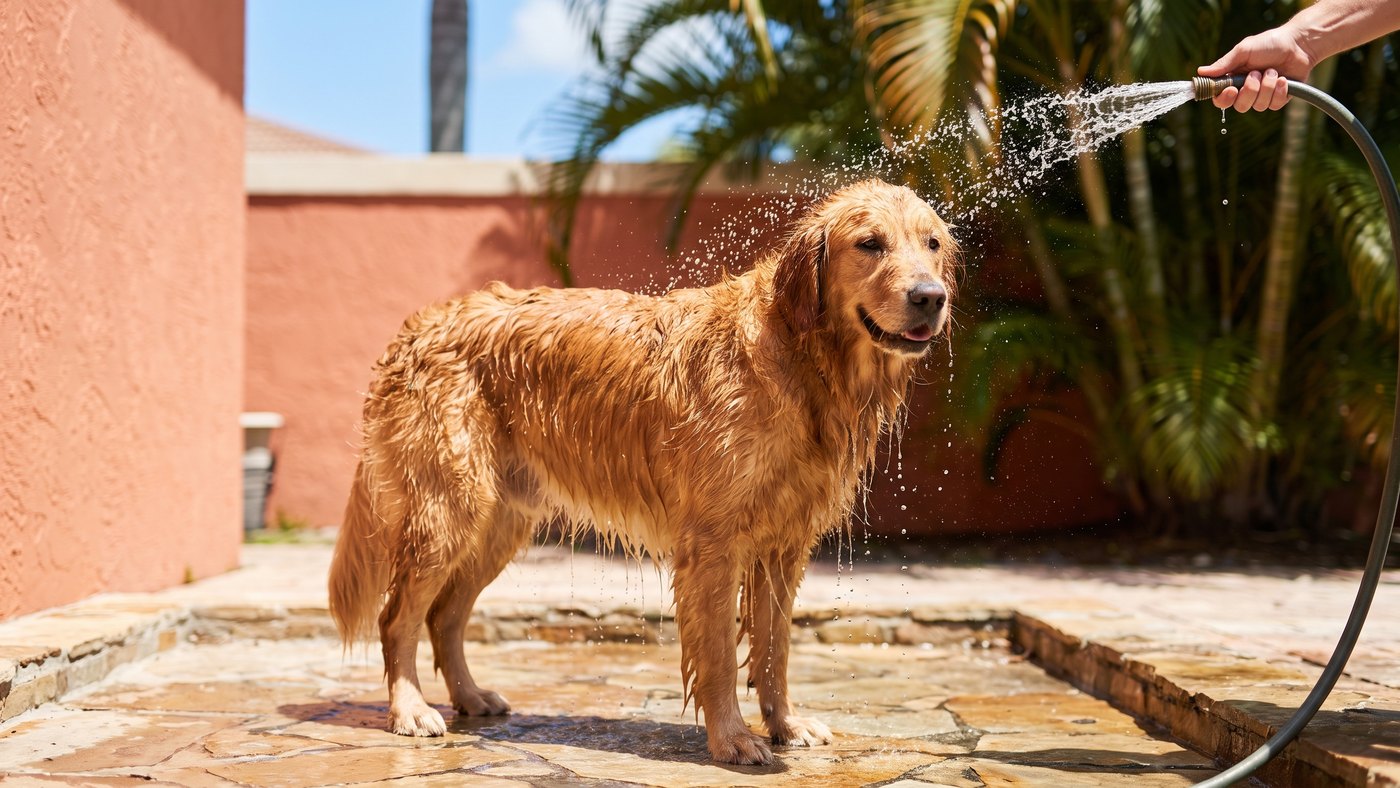
Most shampoo advice is written for a climate that has a winter. Ours does not. In Palm Beach County a coat that gets wet at nine in the morning is still faintly damp at noon, the humidity keeps skin folds warm and closed, and fleas never get the killing frost that gives northern dogs a three month holiday. That changes what a shampoo has to do here, and it changes how often you should reach for one.
This is a guide to reading the bottle. Not a list of brands, because the brand on the front matters far less than the six lines on the back.
Start with pH, because everything else follows from it
Human skin sits on the acidic side, usually around 4.5 to 5.5. Dog skin sits much closer to neutral. Published figures vary by breed, age, body site and season, which is exactly why you see different numbers quoted, but the working range most veterinary sources give is roughly 6.5 to 7.5. A 2025 paper in Veterinary Dermatology measured how these values shift with age, sex and breed, and the spread inside a single species is real.
Two points of pH does not sound like much. It is a logarithmic scale, so two points is a hundredfold difference in acidity.
There is a second difference that gets less attention and matters more. A dog's epidermis is about three to five cell layers thick. A human's is ten to fifteen. The barrier you are washing is thinner, and it is doing its job with less margin.
Put those together and the advice writes itself. Human shampoo, even the gentle baby kind, is formulated to sit correctly on skin that your dog does not have. One emergency bath with what is in your shower will not ruin an animal. Making it the routine will, slowly, by keeping the barrier slightly wrong all the time.
What the label should say
Look for these, in this order.
A stated species. "For dogs" or "for cats" is not marketing. It is the manufacturer telling you which skin they formulated for. A bottle that says "for pets" without distinguishing is a bottle that has not thought about the difference, and the difference between dogs and cats is the one that can kill.
Soap free, and a named mild surfactant. Cocamidopropyl betaine, decyl glucoside, coco glucoside. These clean without stripping. They are not exotic and they are not expensive.
Something that puts oil back. Ceramides, colloidal oatmeal, aloe, glycerin, squalane. In a humid climate you are washing more often than a dog in Vermont, so replacing lipids is not a luxury feature.
A short list. Twelve ingredients you can mostly pronounce beats thirty five you cannot.
What should give you pause
Sodium lauryl sulfate high in the list. It cleans well and it strips well, and on a five cell epidermis that is the wrong trade. Sodium laureth sulfate is milder, but if either sits in the first three ingredients on a shampoo you plan to use weekly, keep looking.
Fragrance, unqualified. The word covers a mixture the manufacturer does not have to disclose. On a dog with no skin problems this is usually nothing. On an itchy dog it is a variable you cannot control, and Florida gives you enough of those already.
Essential oils, and here we have to be blunt. Tea tree oil in particular. A study published in the Journal of the American Veterinary Medical Association reviewed 443 cases of concentrated tea tree oil toxicosis in dogs and cats over a decade. Dilute tea tree oil in a properly formulated product is a different thing from the concentrated oil, but "natural" on the front of a bottle tells you nothing about which one you are holding.
A grooming product that also claims to kill fleas. Not because it is dangerous by definition, but because flea control that works in Florida is not a fifteen minute bath. See below.
Cats are not small dogs, and this part can kill
If you take one thing from this article, take this.
Never put a dog product on a cat without reading it, and never assume a product marketed for both was formulated for both.
Permethrin is the reason. Dog flea products commonly contain 45 to 60 percent permethrin. Cat safe products, where permethrin appears at all, sit below 0.1 percent. Cats cannot process it the way dogs do: their liver is short on the glucuronide conjugation pathway that clears it, so it accumulates and concentrates in nervous tissue. The American Association of Feline Practitioners describes signs running from restlessness and drooling to tremors, seizures and death, and notes that this remains one of the most common causes of poisoning in cats worldwide.
The part owners rarely hear: the cat does not have to be the one you treated. A cat that grooms a dog who was recently treated can be poisoned by the contact. In a house with both animals, that is not a hypothetical.
The same enzyme gap explains the essential oil warnings. Cats are deficient in glucuronyl transferase, which is why oils that a dog tolerates can put a cat in trouble.
If a cat is exposed, this is an emergency and not a wait and see. Rinse and call your vet. The ASPCA Animal Poison Control Center runs a 24 hour line at (888) 426-4435, and there is a consultation fee.
What Florida does to the equation
Three things, and all three point the same way.
Humidity keeps skin wet longer than you think. Malassezia, the yeast behind a great deal of chronic itching, thrives in warm damp conditions. Ears, paws, armpits and skin folds are where it settles, because those are the places that stay closed and warm. A dog bathed and left to air dry in August is a dog whose undercoat is still holding moisture hours later.
Hot spots need three ingredients: moisture, heat and something that started the itch. We have the first two on tap from May through October. The third is usually fleas or allergy. This is why a hot spot can go from nothing to the size of a business card overnight here, and why the wet coat that seems harmless is not.
Fleas never stop. Florida carries about the heaviest flea burden in the country, and the practical consequence is that flea control is a year round prescription product, not a seasonal shampoo. A flea shampoo kills what is on the animal at that moment. It does nothing about the far larger population of eggs and larvae in the carpet and the yard, which is where most of an infestation actually lives.
How often, and why more is worse here
The general guidance for a healthy dog with no skin condition is a bath every four to six weeks, unless a veterinarian has told you otherwise. Medicated shampoos are a different regimen entirely and come with instructions about contact time, usually five to ten minutes, that people routinely ignore. A medicated shampoo rinsed off after thirty seconds is an expensive way to get a wet dog.
Florida bends this in both directions at once. Salt water and pool chemistry argue for rinsing more. Skin barrier health argues for shampooing less. Both are satisfied by the same habit: rinse often, shampoo rarely.
After the beach, rinse with fresh water for a good five minutes, longer than feels necessary, and pay attention to paw pads and the belly where salt collects. After the pool, rinse the same way. Neither needs shampoo. Through swim season, one gentle moisturizing bath a week is a reasonable ceiling for a dog swimming most days, and most dogs are not swimming most days.
Cats are a separate answer. A healthy cat with normal grooming behavior mostly does not need bathing at all. A cat that suddenly stops grooming, or a long haired cat with mats forming, is telling you something that a bath will not fix.
Drying is half the bath
This is the step that gets skipped, and in this climate it is the step that matters most.
Towel first and properly, then get air moving. A dryer on a cool or low setting, or a fan and a well ventilated room. Work through to the skin on a double coated dog rather than fluffing the top. Check the places that hold water: behind the ears, under the collar, the armpits, between the toes, the tail base, and any fold on a flat faced breed.
A coat that is dry to the hand can still be damp underneath. That damp undercoat, in ninety degree heat, is the exact condition that yeast and hot spots are waiting for.
When shampoo is the wrong tool
Shampoo manages a healthy coat. It does not treat disease, and reaching for a stronger bottle is the most common way owners lose two weeks.
See a veterinarian rather than the shelf if you find: a spot that grows day to day, a smell that returns within a day of bathing, hair loss in a defined shape, thickened or blackened skin, an ear that is painful to touch, or itching that keeps the animal awake. Those are diagnoses, not grooming problems, and several of them look identical to each other until someone puts a sample under a microscope.
We keep a list of the clinics we have actually walked into in our own friends directory, with the hours we could verify and none that we could not.
What we do
On our visits, a rinse after the beach is part of the walk, not an extra. We dry to the skin rather than to the touch, and we tell you what we found while doing it, because a hand run through a coat weekly is the earliest warning system there is. A hot spot caught at the size of a dime is a bad afternoon. The same spot on Friday is a vet bill.
If you want a second opinion on what is in the bottle under your sink, bring it out when we come by. Reading a label together takes two minutes.


Discussion
Questions get answered here. Reading is open to everyone.
Every comment is read by an automatic check before it appears. Phone numbers, emails and offers of pet care go to a moderator instead of the page.
Sign in to join the discussion. Reading is open to everyone; posting, replying and voting need an account, which keeps the comments answerable to a real person. Sign in or create an account
- Nobody has said anything yet. If the article left a question open, ask it here and we will answer.